




Listen to this article
Estimated 5 minutes
The audio version of this article is generated by text-to-speech, a technology based on artificial intelligence.
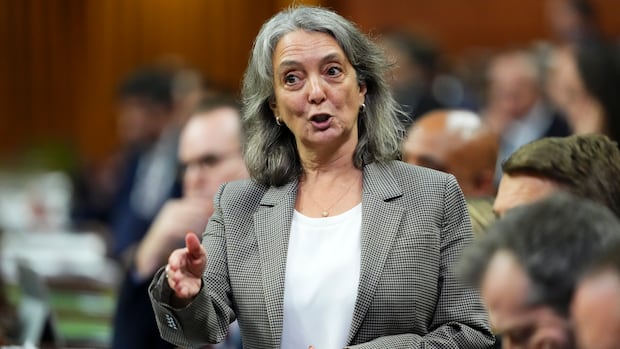
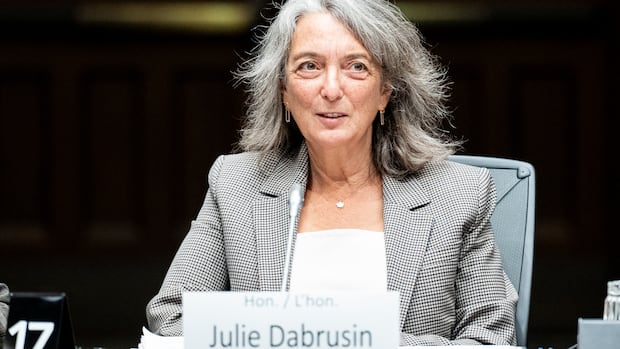
The federal environment minister told a committee of MPs on Monday that the Liberal government remains committed to its 2030 emissions-reduction targets despite striking a deal with Alberta last week outlining the conditions for a new bitumen pipeline.
During her Monday appearance before the House of Commons environment committee, Julie Dabrusin was pressed by the Conservatives for having overly stringent environmental policies and by the Bloc Québécois for not doing enough to fight climate change.
“Do you still commit to respecting the greenhouse gas emissions target of Canada, by 2030, the current goal?” Bloc MP Patrick Bonin asked Dabrusin in French.
“Yes,” answered Dabrusin in French.
“So you still commit to respecting that?” Bonin asked a second time.
“Yes,” the minister said before elaborating that while the Liberal government is committed to working toward the target, it's an "ambitious" one to meet.
WATCH | Environment minister on Canada's 2030 target:During a parliamentary committee on Monday, Bloc Québécois MP Patrick Bonin pressed Environment Minister Julie Dabrusin on her commitment to Canada's 2030 environmental targets.“I have already stated that these are targets that are ambitious,” Dabrusin said in French. “We have to keep on working toward it and we are determined to keep working toward those targets.”
Shortly after coming into office in 2015, the Liberal government signed onto the Paris Agreement targets to cut greenhouse gas emissions 40 to 45 per cent below 2005 levels by 2030.
The Trudeau-era Canadian Net-Zero Emissions Accountability Act requires the federal government publish an update on climate progress at the end of every calendar year.
Asked Sunday in an interview with CBC's Rosemary Barton Live whether that forthcoming report will show meeting the 2030 reduction target is even feasible, Dabrusin said that document "will show that we have a lot more work to do. But we're still determined to keep working towards it."
"I have more things I need to do to get there," Dabrusin said.
The 2024 report showed that Canada's emissions have been reduced by about 7.1 per cent since 2005.
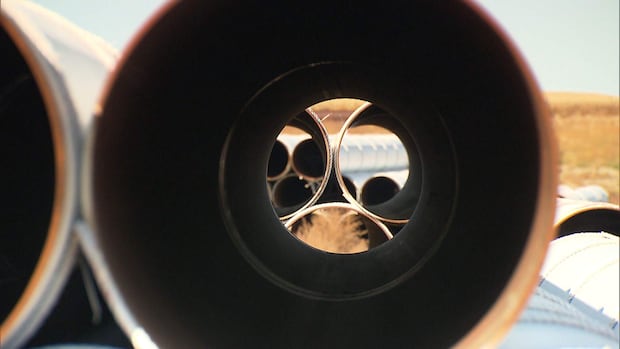
Pipeline conditions establishedLast week, Prime Minister Mark Carney and Alberta Premier Danielle Smith signed a memorandum of understanding (MOU) that laid out the conditions for federal support for a bitumen pipeline to the B.C. coast.
Bonin asked the environment minister if building a pipeline would reduce or increase Canada’s greenhouse gas emissions, or in any way help in the fight against climate change.
Dabrusin pointed out that a pipeline will only happen in conjunction with Pathways Plus, an Alberta-based carbon capture, utilization and storage project, which could reduce the emissions intensity of exports from the province's oilsands.
Bonin pressed Dabrusin several times to answer whether a new pipeline would either increase or decrease emissions, but she did not answer. Dabrusin also would not affirm her support for the pipeline. She said only that her government would facilitate its approval if Alberta, B.C. and First Nations along the route come to an agreement.
Conservative MPs on the committee asked Dabrusin whether that meant B.C. or First Nations had the power to veto the pipeline.
“If one First Nation, out of many First Nations that will be affected by the pipeline and the tanker ban, doesn’t give their consent, is this project going to end?” asked Ellis Ross, the MP for the B.C. riding of Skeena-Bulkley Valley, which includes parts of the province’s Pacific coast.
Dabrusin said the MOU requires a number of benchmarks to be hit. One of those is a route for the proposed pipeline which has not been decided, so she said she would not answer a hypothetical question.
EV mandate to come after review, says ministerCarol Anstey, the Conservative MP for Long Range Mountains in Newfoundland, asked Dabrusin what the Liberal government’s plans are for its electric vehicle mandate.
Former prime minister Justin Trudeau brought in the mandate requiring the number of new zero-emission vehicles sold in Canada to hit 20 per cent by next year, 60 per cent by 2030 and 100 per cent by 2035 in order to help the country hit its emission-reduction target.
The Trump administration’s tariffs and its move away from support for EVs, combined with slowing sales in Canada, have prompted automakers north of the border to lobby the Liberal government to scrap or adjust the mandate.
To address those concerns, Carney announced in September that he was pausing the minimum sales levels for EVs until a 60-day review could be completed.
Anstey said EV mandates do not make sense for Canadians living in rural areas where the drive to access health care could be as long as 1,000 kilometres.
“Do you personally support removing the mandates, you as environment minister?” Anstey said.
Dabrusin ducked that question, saying her government is still reviewing the federal EV mandate and will not reveal what it is going to look like until that review is complete.
“I am in a period of review,” she said. “I will be releasing, shortly, the full policy.”