


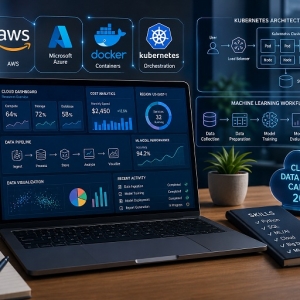




This shift is reshaping classrooms across the United States. Universities are introducing AutoML tools into data science, analytics, and computer science programs because employers increasingly expect graduates to understand automated machine learning workflows. While automation simplifies technical work, it also raises the importance of critical thinking, data quality, and ethical decision-making.
AutoML Is Changing How Students Learn Machine Learning
Traditional machine learning projects required students to clean datasets, engineer features, compare algorithms, tune hyperparameters, and evaluate dozens of model variations manually. It was valuable experience, but also time-consuming.
Modern AutoML platforms automate much of this workflow. After selecting a dataset and defining a prediction target, students can allow the platform to test numerous algorithms, optimize parameters, and rank the best-performing models automatically.
Think of it like using GPS navigation. Years ago, drivers relied on paper maps and calculated every turn themselves. GPS now handles route planning instantly, but drivers still need to understand where they're going and recognize when a suggested route doesn't make sense. AutoML works the same way. It automates the route, but people remain responsible for making good decisions.
Instead of spending most of their time debugging code, students spend more time asking important questions:
- Is the data reliable?
- Which evaluation metric best fits this problem?
- Can the model be trusted?
- Will the results remain accurate over time?
Those questions reflect the work employers increasingly value.
The Skills That Matter Most in 2026
AutoML has not reduced the need for machine learning knowledge. Instead, it has shifted attention toward stronger fundamentals.
Students still need to understand statistics, supervised learning, regression, classification, cross-validation, and evaluation metrics such as precision, recall, F1-score, AUC, and RMSE. These concepts determine whether an automatically generated model is actually useful or simply appears accurate.
Data quality has become even more important because AutoML cannot repair poor datasets. Missing values, biased samples, incorrect labels, and inconsistent records will still produce weak predictions regardless of how advanced the automation becomes.
Another growing priority is explainable AI. Organizations want professionals who can explain why a model made a prediction rather than simply accepting leaderboard rankings. Students therefore need experience interpreting feature importance, understanding model limitations, and communicating findings to technical and non-technical audiences.
These human skills cannot be automated.
Popular AutoML Platforms Every Student Should Explore
Several AutoML platforms dominate education and industry in 2026.
Open-source frameworks such as Auto-Sklearn, TPOT, AutoGluon, and H2O AutoML allow students to build complete machine learning pipelines using Python. These tools are excellent for learning because they expose many underlying machine learning concepts while reducing repetitive coding.
Cloud platforms have also become widely used.
Google Vertex AI AutoML provides low-code development for image recognition, natural language processing, and structured data. Microsoft Azure Automated ML offers visual workflows that help beginners build predictive models without extensive programming experience.
Enterprise platforms such as DataRobot extend AutoML beyond experimentation by supporting governance, monitoring, documentation, and production deployment. Even if students never use these commercial platforms during university, understanding how they fit into business operations provides valuable career preparation.
Learning multiple platforms also helps students understand that AutoML is not tied to a single vendor but represents a broader shift in machine learning development.
Why Universities Are Updating Their Data Science Curriculum
Many universities are redesigning machine learning courses to reflect industry expectations.
Rather than replacing traditional programming exercises, instructors are combining manual model development with AutoML projects. Students first build models themselves before comparing the results with automated pipelines. This approach helps learners understand where automation performs well and where human expertise remains essential.
Coursework is also placing greater emphasis on production-ready thinking. Students learn how AutoML models move beyond notebooks into cloud environments, APIs, monitoring systems, and business applications.
Communication has become another essential skill. Data scientists increasingly collaborate with healthcare professionals, financial analysts, marketing teams, and executives. Graduates who can explain machine learning results clearly often deliver greater business value than those who only write code.
When students encounter complex assignments involving AutoML workflows, hyperparameter optimization, or model evaluation, resources such as Expertsmind.com's subject expert network can help clarify concepts, review projects, and strengthen understanding without replacing the learning process.
AutoML Creates Better Career Opportunities
The rise of AutoML does not mean fewer opportunities for data scientists. Instead, it changes the skills employers seek.
Companies increasingly want professionals who understand business objectives, evaluate automated results, ensure fairness, identify bias, and monitor deployed models over time. Technical implementation is becoming faster, but strategic decision-making remains entirely human.
Healthcare organizations use AutoML to improve patient outcome predictions. Financial institutions automate fraud detection and credit scoring. Retail companies forecast customer demand and personalize recommendations. Every industry benefits from faster model development, but each still depends on professionals who understand the underlying data and can validate automated decisions.
Students who combine strong statistical knowledge with AutoML expertise will likely enjoy broader career opportunities because they can work across both technical and business-focused teams.
Preparing for the Future of Machine Learning
AutoML is no longer an experimental technology. It has become part of the standard toolkit used by modern data scientists, analysts, and machine learning engineers.
Students should begin by mastering Python, data analysis, and basic machine learning concepts before exploring AutoML libraries and cloud platforms. Building projects that compare manual models with automated pipelines provides valuable practical experience while strengthening conceptual understanding.
The biggest lesson from AutoML in 2026 is simple. Automation handles repetitive work, but it cannot replace curiosity, sound judgment, ethical reasoning, or clear communication. Those abilities continue to define successful data scientists, and they will remain valuable long after today's AutoML tools evolve into tomorrow's intelligent systems.