

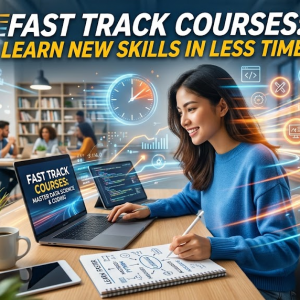


Fast track mode courses have become a popular search topic among students, working professionals, and career switchers who want to complete education in a shorter time. These programs are often promoted as accelerated learning options that help learners progress faster compared to traditional academic timelines.
However, it is important to understand what fast track mode actually means, how it works, and what is realistically possible under recognized education systems. This guide explains fast track courses in detail, including their structure, eligibility, benefits, limitations, and how to verify their validity before enrolling.
Understanding Fast Track Mode Courses
Fast track mode courses refer to accelerated learning pathways designed to help students complete part of their education in a shorter duration than traditional programs.
These courses may be offered in different formats such as:
- Short-term certification programs
- Skill-based training courses
- Modular learning programs
- Credit-based academic pathways (in some institutions)
- Flexible or blended learning systems
The key idea behind fast track learning is efficiency in education, not bypassing academic requirements.
Are Fast Track Courses the Same as Regular Degrees?
No. Fast track courses are not always equivalent to regular degree programs.
A standard degree follows a fixed academic structure regulated by universities or education boards, including:
- Minimum duration requirements
- Defined curriculum
- Practical/lab work (for technical fields)
- Exams and assessments
- Research or project work
Fast track learning may reduce time only in cases where:
- Prior learning is recognized
- Credits are transferred
- Students already have relevant qualifications
- Flexible academic systems are permitted
It is not a universal shortcut to completing a degree in a reduced timeframe.
How Fast Track Mode Works
Fast track education works through structured academic flexibility. Common mechanisms include:
1. Credit Transfer System
Students who have already completed relevant subjects from a recognized institution may transfer those credits to a new program.
2. Recognition of Prior Learning (RPL)
Some institutions assess a learner’s:
- Work experience
- Skills
- Previous training
and may grant academic credit where applicable.
3. Lateral Entry
Students may enter directly into an advanced stage of a program based on prior qualifications.
4. Modular Learning
Courses are divided into modules that can be completed at an accelerated pace depending on student capability.
5. Flexible Learning Schedules
Weekend classes, online learning, or blended formats allow students to progress faster while managing work or personal commitments.
Who Can Apply for Fast Track Mode Courses?
Eligibility depends on the institution and course type, but commonly includes:
1. Students with Prior Education
Candidates who have completed partial or related studies may be eligible for advanced entry or credit transfer.
2. Working Professionals
Individuals with industry experience in fields such as IT, management, engineering, or commerce may benefit from flexible learning options.
3. Discontinued Students
Students who previously left a program may resume studies if their earlier credits are accepted.
4. Skill-Based Learners
Candidates with vocational training or certifications may qualify for certain bridge programs.
Popular Fast Track Course Categories
Fast track learning is available across multiple fields, including:
Business & Management
- MBA
- BBA
- Business Analytics
Computer Applications
- MCA
- BCA
- IT certifications
Commerce
- BCom
- MCom
Arts & Humanities
- BA
- MA
Science & Technical Fields
- BSc
- MSc
- Engineering diplomas (select pathways)
Benefits of Fast Track Mode Courses
Fast track learning offers several advantages when properly structured and recognized:
1. Time Efficiency
Students may complete portions of their education faster through flexible academic pathways.
2. Career Growth
Faster completion may help learners enter or progress in the job market sooner.
3. Skill Enhancement
Many fast track programs focus on practical and industry-relevant skills.
4. Flexibility for Working Professionals
Working individuals can balance education and employment more effectively.
5. Cost Efficiency (in some cases)
Reduced study duration may lower overall educational expenses depending on the program structure.
Limitations of Fast Track Courses
Despite the benefits, there are important limitations:
1. Not Universally Available
Not all universities or institutions offer fast track options.
2. Strict Eligibility Requirements
Only candidates with prior qualifications or experience may qualify.
3. Academic Validity Concerns
Students must verify whether the program is recognized by relevant authorities.
4. Misleading Marketing
Some programs may use the term “fast track” loosely, so careful verification is essential.
5. Heavy Study Load
Accelerated learning can be intensive and demanding.
How to Verify a Genuine Fast Track Program
Before enrolling, students should carefully check:
- University or institution recognition
- Accreditation status
- Official course structure
- Duration and credit requirements
- Examination and assessment system
- Eligibility criteria
- Career acceptance of the qualification
Always confirm details directly from official sources rather than promotional claims.
Common Myths About Fast Track Courses
Myth 1: Anyone Can Complete a Degree Quickly
Not true. Eligibility is required for accelerated pathways.
Myth 2: Fast Track Means Low Quality
Not necessarily. Many structured programs maintain academic standards.
Myth 3: All Degrees Can Be Finished in One Year
Incorrect. Most degrees have minimum duration requirements.
Myth 4: Experience Alone Replaces Education
Experience may support learning recognition, but does not fully replace academic requirements.
Career Opportunities After Fast Track Courses
Career outcomes depend on the qualification earned. Possible roles include:
- Business Executive
- Software Developer
- Accountant
- Data Analyst
- Marketing Executive
- HR Associate
- Technical Assistant
- Research Associate
Career success depends on skills, experience, and recognized qualifications.
Fast Track Courses vs Regular Courses
|
Feature |
Fast Track Mode |
Regular Course |
|
Duration |
Flexible/Reduced (where allowed) |
Fixed duration |
|
Eligibility |
Often stricter |
Standard |
|
Structure |
Modular or credit-based |
Fixed curriculum |
|
Flexibility |
High |
Moderate |
|
Recognition |
Depends on institution |
Generally standardized |
Frequently Asked Questions
What are fast track mode courses?
They are flexible or accelerated learning programs designed to help eligible students complete education in less time through structured academic systems.
Are fast track courses valid?
Yes, if offered by recognized institutions and approved under academic regulations.
Can I complete a degree in one year?
Only in very limited cases depending on prior qualifications and institutional policies.
Are fast track courses suitable for working professionals?
Yes, many programs are designed specifically for working learners.
Conclusion
Fast track mode courses are designed to provide flexible and accelerated learning opportunities for eligible students and professionals. However, they are not a universal shortcut to completing degrees in a shorter time. Their structure depends on institutional policies, prior learning recognition, and academic regulations.
Before enrolling, it is important to verify recognition, understand eligibility requirements, and ensure the program aligns with your long-term educational and career goals. When chosen carefully, fast track learning can be a valuable pathway for skill development and career advancement.