






An Icon Born From a Single Idea
In 1965, Seiko did something no Japanese watchmaker had done before: it built a diver's watch. That original model, now known among collectors as the "62MAS," was simple by today's standards, but it launched a philosophy that still defines Seiko's sports watches six decades later. That philosophy eventually got a name — Prospex, short for "Professional Specifications" — and a mission statement that has barely changed since: build watches tough enough for professionals in the harshest conditions on Earth, and make them good enough that everyone else wants to wear them too.
Seiko's own tagline for the line captures it well: Prospex watches are for "sports lovers and adventure seekers whether in the water, in the sky or on land." It's a broader promise than most brands make, and Prospex has spent decades backing it up.
Six Decades of Firsts
What sets Prospex apart from most sport watch collections is how many genuine engineering firsts it can claim. After the original 1965 diver, Seiko released a 300-meter "Professional" diver in 1968, powered by Japan's first hi-beat movement. In 1975, the company went further still, producing the world's first 600-meter professional diver's watch with a titanium case. Three years later, in 1978, Seiko released the first quartz-powered saturation diving watch, also rated to 600 meters. These weren't incremental updates; each one solved a real problem professional divers were facing at the time, from magnetism resistance to corrosion to accuracy under pressure.
That original 1965 diver even had a taste of real exploration: it accompanied members of the Japanese Antarctic Research Expedition on their journey to the South Pole between 1966 and 1969, a detail that still shows up in Seiko's own marketing today as proof the watch could handle conditions most people will never face.
Three Elements, One Collection
Seiko organizes the modern Prospex lineup around three environments: sea, sky, and land.
The Sea collection is the most famous, home to Seiko's dive watches and the models that earned nicknames from fans over the years — the "Tuna," "Sumo," "Samurai," and "Turtle" among them. The Tuna's name comes from its rounded titanium case wrapped in a protective outer shroud, a shape collectors think resembles a can of tuna fish. Several current Sea models are rated to withstand depths of up to 1,000 meters, a level of over-engineering few divers will ever need but that speaks to the collection's obsession with margin for error.
The Land collection centers on the Alpinist line, which traces back to watches Prospex Seiko built in the 1960s for Japanese mountaineers. These models tend to lean a bit dressier than the dive watches, with compass-adjacent bezels and a warmer, more vintage aesthetic.
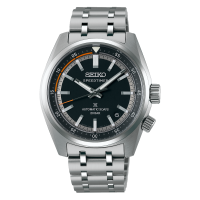
The Sky collection covers pilot's watches, GMTs, and the Speedtimer chronograph series, which pays tribute to Seiko's history as an official timekeeper for events like the World Athletics Championships. Some Speedtimer models mark the 40th anniversary of Seiko's 1983 analog quartz chronograph, blending heritage design with modern solar movements capable of measuring time to 1/100th of a second.
At the top of the range sits Prospex LX, the collection's most luxurious tier, which brings in premium finishing and, in select models, Seiko's Spring Drive technology, a hybrid between mechanical and quartz movement design that Seiko engineered in-house.
What's Actually Inside
Seiko builds much of the Prospex catalog around in-house calibers. The 8L series are high-torque, hand-assembled automatic movements made specifically for demanding sports use, while the 8R chronograph calibers use a vertical clutch and column wheel for smoother pushers. The 6L37 caliber lets Seiko build slimmer diver's watches without sacrificing water resistance certification, and the newer 6R movements now offer up to 72 hours of power reserve. For buyers who'd rather skip winding altogether, solar-powered Prospex models recharge from any light source and never need a battery.
Buying Into the Legacy
Prospex prices span a wide range. Solar and quartz models start at a few hundred dollars, automatic divers with in-house movements generally land between roughly $400 and $1,000, and limited editions can climb toward $3,000 or more. The Prospex LX line, especially Spring Drive references, sits at the top of the range, often in the $4,000 to $5,000 territory.
2025 marked the 60th anniversary of Seiko's original diver's watch, and the brand marked the occasion with new commemorative pieces added to the Prospex collection, a reminder that six decades in, the line is still very much moving forward rather than resting on its history. For anyone drawn to watches with a genuine story behind the engineering, Prospex remains one of the most credible names in the business.