











The end of a relationship rarely announces itself cleanly. Even when it’s the right decision, even when it was a long time coming, the aftermath arrives in waves and often when you least expect it.
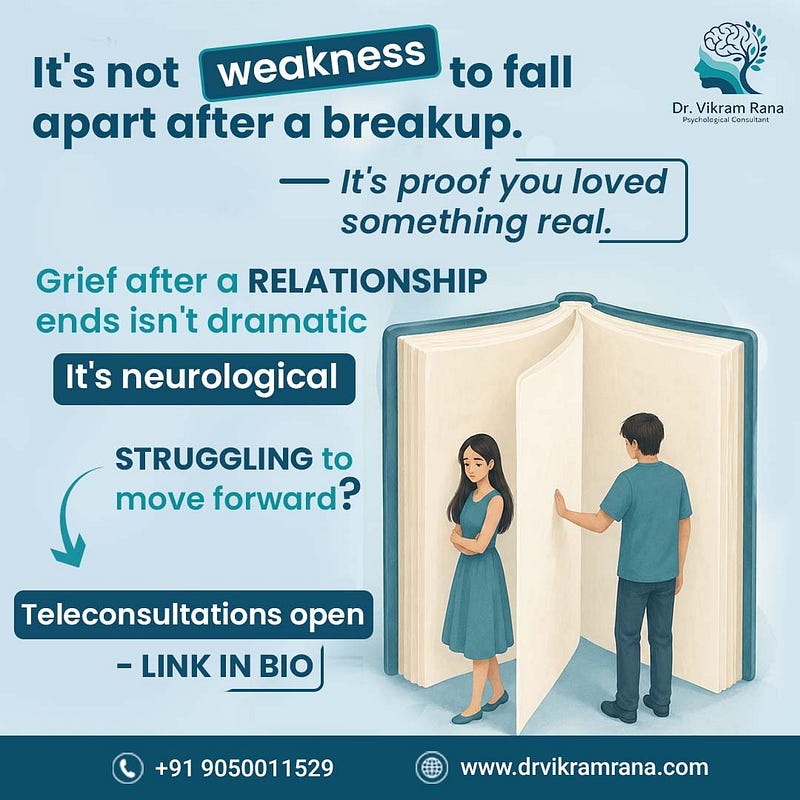
One morning you wake up and feel fine. By afternoon, a song, a smell, a particular stretch of road undoes you completely. You find yourself replaying conversations, rewriting endings, wondering what you could have said differently. You miss someone you know, rationally, you shouldn’t. And then you feel guilty for missing them. And then you feel guilty for not missing them enough.
If any of this sounds familiar, I want to say something clearly: you are not falling apart. You are grieving. And grief after a relationship ends is one of the most misunderstood, most underestimated forms of loss a person can experience.
Why Breakups Hurt the Way They Do
There is a reason heartbreak feels physical. Neuroscience has confirmed what humans have always known intuitively — the brain processes social rejection and emotional loss through many of the same neural pathways as physical pain. When a significant relationship ends, the brain responds with genuine distress signals. The body experiences withdrawal from the neurochemicals — dopamine, oxytocin, serotonin — that the relationship consistently provided.
This isn’t metaphor. This is biology.
And yet, we live in a culture that tells people to bounce back quickly, to move on, to not let it affect their work or their social life or their outward presentation of being fine. We extend enormous compassion to people grieving other kinds of loss. We give them time and space and understanding. But heartbreak is routinely minimised, treated as something to push through rather than something to move through.
The result is that a great many people carry unprocessed grief from relationships long past, grief that shows up years later as patterns they don’t understand, walls they didn’t consciously build, or a persistent wariness about letting people in.
What Grief After a Relationship Actually Looks Like
Healing from a breakup rarely follows a straight line. It doesn’t proceed politely through defined stages. It circles back. It catches you off guard in mundane moments. And it often involves feelings that seem contradictory — relief and devastation, anger and tenderness, clarity and confusion — sometimes within the same hour.
What I see in my practice is that the people who struggle most after a breakup are often not struggling with the loss of the person alone. They are grappling with the loss of the future they had imagined. The home they were building in their mind. The identity that had quietly wrapped itself around the relationship — partner, significant other, the person who someone chose.
When that relationship ends, it isn’t just the present that shifts. It’s the entire landscape of the future. That is a profound loss. It deserves to be treated as one.
What Healthy Processing Actually Requires
Suppressing emotion doesn’t resolve it. It relocates it. The feelings that aren’t processed consciously tend to resurface — in physical tension, in disrupted sleep, in irritability, in the next relationship where old wounds silently shape new dynamics.
Healthy processing after a breakup involves allowing yourself to feel without judgment, understanding the patterns and needs the relationship was meeting, rebuilding your sense of individual identity outside of the partnership, and giving yourself permission to grieve without a timeline.
It also means resisting the urge to use distraction constant socialising, overworking, immediately dating again as a substitute for genuine emotional processing. Staying busy delays the work. It doesn’t eliminate it.
You Don’t Have to Navigate This Alone
There is a particular kind of courage in acknowledging that you are struggling and choosing to seek support rather than simply waiting for time to do the work on its own. Healing happens faster, and more completely, when it’s guided, when there is a safe, confidential space to examine not just what happened, but what it meant, what it revealed, and what it can teach you about yourself.
Your pain after this relationship ended is not a sign of weakness. It is evidence of how deeply you were able to connect with another person. That capacity is not something to close off. It’s something to understand, protect, and ultimately bring forward into a clearer, more grounded version of yourself.
That is what recovery looks like. Not getting over it. Getting through it with greater self-knowledge on the other side.
Dr. Vikram Rana | Psychology Consultant | Psycho-Oncology & Corporate Wellbeing