


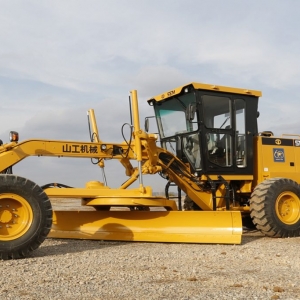




Walk past any highway expansion site in Abu Dhabi or a new industrial road cutting through Sharjah, and you'll spot one machine doing the quiet, unglamorous work that makes everything else possible: the motor grader UAE. It doesn't get the attention that excavators or cranes get. Nobody photographs it for a project brochure. But without it, roads don't sit flat, drainage doesn't fall the right way, and every layer poured on top starts on a bad foundation.
In the UAE, where infrastructure spending keeps pushing outward into the desert, the motor grader has become one of the most consistently in-demand pieces of heavy equipment on the market. Here's why it matters, and what actually goes into choosing and running one in this climate.
What a Motor Grader Actually Does
At its simplest, a motor grader takes a long, angled blade and drags it across a surface to shape, level, and finish it. That sounds basic until you watch an experienced operator work one — tilting the blade a few degrees, shifting the moldboard side to side, cutting a camber into a road bed so water runs off instead of pooling. It's closer to a craft than most people assume.
The main jobs on a UAE site usually break down into a few categories:
- Fine grading — levelling the base and sub-base layers before asphalt or concrete goes down
- Slope and drainage work — cutting the right fall so roads and yards shed water correctly, which matters more here than people think given how flash flooding hits during the rainy months
- Maintenance grading — keeping unpaved haul roads, site access tracks, and rural roads usable under constant heavy traffic
- Cut-to-grade work — bringing a surface down to exact design elevation ahead of paving
On a big highway job, the grader might touch a stretch of road three or four times before it's ever considered finished.
Desert Conditions Change the Equation
Anyone who's specced equipment for the region will tell you the same thing: what works in Europe doesn't automatically work here. Sand isn't soil. It shifts under the blade; it doesn't compact the way clay-heavy ground does, and fine dust gets into everything — filters, hydraulics, cooling systems — faster than most operators expect coming from other markets.
Heat is the other variable nobody skips over for long. Engine cooling and hydraulic cooling both get stressed when ambient temperatures sit above 45°C for months at a time. This is where blade specification and undercarriage choice actually matter, not just as a spec sheet exercise but as the difference between a machine that lasts a full project lifecycle and one that's back in the workshop every few weeks.
A few things tend to separate a grader that copes well from one that struggles:
- Reinforced cooling packages built for sustained high-ambient operation
- Sealed and shielded hydraulic lines to keep sand out
- Cab pressurisation and filtration, partly for dust, partly because an operator who's fighting heat and grit for ten hours makes worse decisions by hour six
- Blade steel and edge wear packages suited to abrasive ground rather than softer terrain
Buying, Renting, or Both
Contractors here tend to split roughly into two camps. Larger firms with continuous pipeline work often own a small fleet outright, because utilisation stays high enough to justify it. Smaller contractors, or firms bidding on a single large infrastructure package, lean toward rental — it keeps capital free and lets them scale the fleet up or down as the project phases shift.
Whichever route a contractor takes, the same advice keeps coming up from people who've done this for years: buy from a dealer who actually stocks parts locally, not one who's promising a shipment from overseas when your grader is sitting idle. Downtime on a graded surface waiting for a hydraulic hose or an edge blade isn't a minor inconvenience — it holds up every trade behind it on the programme.
Where the Market Is Heading
Road and infrastructure investment across the Emirates hasn't slowed in any meaningful way, and that keeps grading work steady across both government-led projects and private developments. What's shifted more recently is the expectation around uptime and service support — clients want equipment paired with a dealer relationship, not just a machine sale.
That's arguably the more useful lens for anyone evaluating a motor grader purchase or rental in this market: less about horsepower on paper, more about who's answering the phone when a hydraulic seal fails on a Thursday afternoon in July.
FAQs: Frequently Asked Questions
Q: How often does a motor grader need servicing in UAE conditions?
A: More frequently than manufacturer defaults suggest in milder climates. Dust ingress and heat load mean filter changes and hydraulic checks typically need to happen on shorter intervals — most operators here tighten service schedules rather than stretch them.
Q: Is a used motor grader a reasonable option for smaller contractors?
A: It can be, provided the undercarriage and hydraulic system have been properly inspected. Blade and edge wear are easy to spot; heat-related hydraulic degradation is not, so a proper inspection from someone who knows the local operating conditions matters more than the odometer.
Q: What's the biggest mistake contractors make when specifying a grader for this region?
A: Buying on horsepower and blade width alone, without checking the cooling package and filtration spec. That's usually where the real cost shows up later.