







If you have ever walked into a server room that felt a little too warm, opened a pharmaceutical fridge that had been silently drifting out of range, or unloaded a shipment of produce that arrived softer than it should have, you already understand why monitoring environmental conditions matters. The damage in these situations rarely announces itself. It builds quietly, over hours or days, until a batch of vaccines is compromised or a warehouse full of electronics starts corroding from moisture nobody noticed.
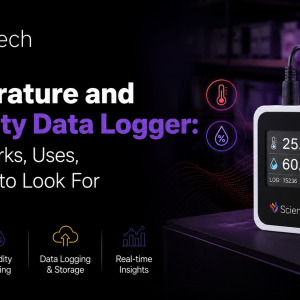
This is exactly the gap a temperature and humidity data logger is built to close. It is a small device, often no bigger than a matchbox or a USB stick, that sits inside a space or a shipment and quietly records conditions at set intervals. No one has to remember to check it every hour. It just works in the background, building a record that can be pulled up the moment something needs to be verified.
In this guide, we will walk through how a temp humidity data logger actually functions, where these devices get used across different industries, and what separates a genuinely useful unit from one that looks good on a spec sheet but falls apart in real conditions. By the end, you should have a clear sense of what to look for if you are shopping for one, whether it is for a home wine cellar or a regulated cold chain operation.
Also Read -
What Is a Temperature and Humidity Data Logger
A temperature and humidity data logger is a standalone electronic device designed to measure and record environmental conditions over time, without requiring a person to manually take readings. Instead of checking a thermometer every few hours and writing down numbers on a clipboard, the device does this automatically, storing timestamped data internally or transmitting it to a connected system.
Most units on the market today combine two sensors in one housing: a temperature sensor and a humidity sensor. This pairing matters because temperature and moisture levels often affect each other, and many products, from food to pharmaceuticals to electronics, are sensitive to both. A temp humidity data logger essentially gives you a continuous, unbiased record of what actually happened in an environment, rather than a snapshot taken at a single point in time.
The appeal is simple. Once you have historical data, you can spot trends, catch problems early, and prove compliance if regulators or clients ever ask for documentation.
How a Temperature Humidity Data Logger Works
At its core, a temperature humidity data logger relies on a few key components working together.
Sensors
The device uses a thermistor or thermocouple to measure temperature, and a capacitive or resistive sensor to measure relative humidity. These sensors convert physical conditions into electrical signals that the internal circuitry can interpret.
Microprocessor and Memory
A small onboard processor reads the sensor data at intervals you set, anywhere from every few seconds to once an hour, depending on the model and the application. This data gets stored in internal memory, which on most modern loggers can hold tens of thousands of readings before it needs to be downloaded or cleared.
Power Source
Most units run on a small battery, often a coin cell, that can last anywhere from several months to a few years depending on how frequently the device logs data. Some loggers, particularly those used in fixed locations like server rooms or warehouses, run on external power instead.
Data Retrieval
Once the logging period is complete, or whenever you need to check on conditions, the data can be pulled off the device in a few different ways. Older and simpler units connect via USB to a computer, where the readings open in a spreadsheet or dedicated software. Newer models use Bluetooth or Wi-Fi, letting you pull data onto a phone or send it automatically to a cloud dashboard. Some higher-end systems even push out real-time alerts the moment a reading crosses a set threshold, which is a significant upgrade over a device that only tells you about a problem after you go looking for it.
This entire process, sensing, recording, storing, and reporting, is what makes a temperature and humidity data logger fundamentally different from a basic thermometer or hygrometer. It is not just measuring conditions at one moment. It is building a timeline you can actually trust.
Types of Data Loggers Available Today
Not every temperature and humidity data logger is built the same way, and understanding the categories helps narrow down what fits your situation.
Standalone loggers operate independently and store data internally until it is downloaded manually. These are common in shipping and cold chain applications where connectivity along the route cannot be guaranteed.
Wireless loggers connect via Bluetooth, Wi-Fi, or cellular networks, sending data to an app or cloud platform in near real time. These suit fixed locations like warehouses, labs, or offices where continuous connectivity is available.
Multi-channel loggers can connect to external probes, allowing one device to monitor several zones or points at once. These tend to show up in larger facilities where a single sensor cannot capture conditions across a big space.
Disposable loggers are inexpensive, single-use devices often included inside a shipment for one trip and then discarded. They are popular in food and pharmaceutical logistics where cost per shipment matters.
Contact Us
For product inquiries, technical assistance, demos, or quotations, contact the Scientech team:
India:
| +91-9755591500
International:
| +91-7389910103
Corporate Office:
Scientech Technologies Pvt. Ltd.
94, Electronic Complex, Pardesipura, Indore-452010, Madhya Pradesh, India.
Final Thoughts
Choosing a temperature and humidity data logger is less about finding the flashiest device on the shelf and more about honestly assessing what you actually need to protect and how much risk you can tolerate if something goes wrong. A home user watching a cigar humidor has very different requirements than a logistics company shipping vaccines across state lines, and the right device for one situation would be complete overkill, or dangerously inadequate, for the other.
What stays consistent across every use case is the value of having a real record instead of a guess. Whether you are troubleshooting a mystery mold problem in a greenhouse or satisfying an auditor's request for cold chain documentation, a reliable logger turns an invisible risk into something you can actually see, measure, and act on before it becomes a costly problem.
Reliable temperature and humidity data loggers for monitoring, recording, and analyzing environmental conditions in various applications.