



For any business that ships, bakes, gifts, or retails products, packaging costs add up fast. White gable boxes have become a go-to choice because they're versatile, attractive, and easy to brand — but buying them one case at a time is expensive. Ordering wholesale is where the real savings happen, provided you know what drives the price up (and down).
This guide walks through everything that affects the cost of wholesale white gable boxes — materials, customization, sizing, sustainability, and supplier strategy — so you can order smarter and stretch your packaging budget further.
Materials & Durability
The material a white gable box is made from directly affects both its price and how well it protects your product.
- Kraft paper — Lightweight and affordable, but offers minimal structural support. Best for lightweight, non-fragile items like favors or light retail goods.
- Cardstock (SBS/folding carton stock) — A step up in rigidity, with a smooth, print-friendly white surface. This is the most common material for standard white gable boxes.
- Corrugated board — Includes a fluted middle layer for cushioning and strength, making it suitable for heavier items, food transport, or products that need extra protection during shipping.
Buying tip: Don't over-buy strength you don't need. Corrugated boxes cost more per unit — if you're packaging lightweight retail items, cardstock will usually deliver the same visual quality at a lower bulk price.
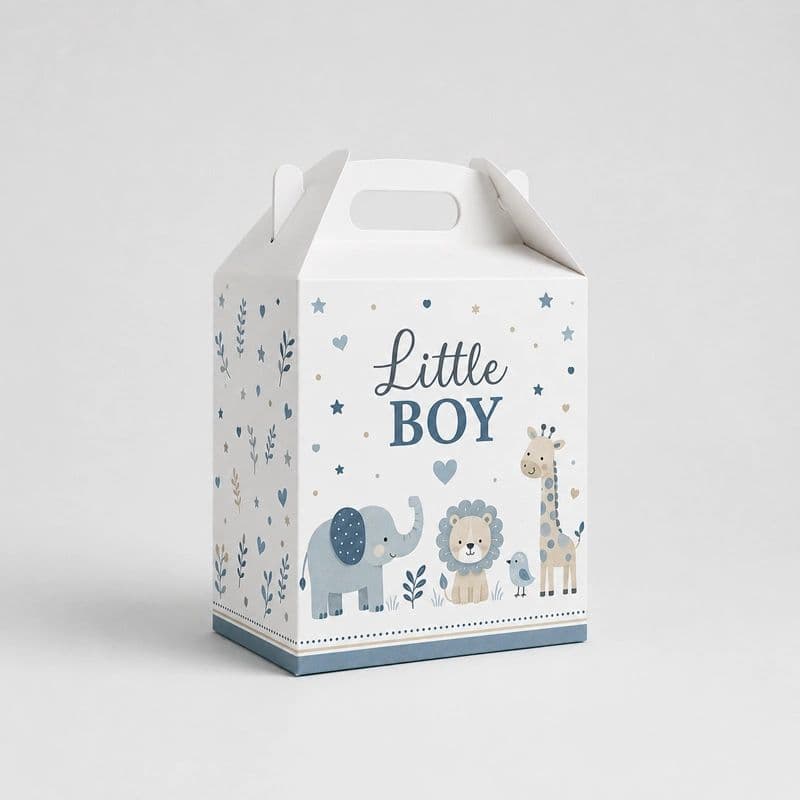
Sizing & Design Specifications
Wholesale pricing is almost always tied to box dimensions, since size determines material usage and shipping volume.
- Standard sizes typically range from small (roughly 4"x4"x4") up to large format boxes (10"+ per side) for bulkier products.
- Folding structure — Gable boxes fold flat for storage and shipping, then pop into shape with the signature peaked-roof lid, which snaps or ties closed at the top.
- Choosing the right size — A box that's too large wastes material (and money) and lets products shift in transit; too small, and it won't close properly or protect the contents. Measure your product's exact dimensions and add a small buffer rather than rounding up to the next "safe" size.
Buying tip: Standardizing on 2-3 sizes across your product line — rather than ordering a custom size for every SKU — is one of the simplest ways to unlock better wholesale pricing, since suppliers can produce larger runs of fewer die-cut templates.
Customization Options
Customization is often where wholesale costs swing the most, since printing and finishing are priced separately from the base box.
- Printing — Ranges from single-color logo stamping to full-color CMYK branding across the entire box.
- Embossing/debossing — Raised or recessed detailing for a premium, tactile finish.
- Window cutouts — Die-cut openings (often with a clear film insert) to showcase the product inside.
- Foil stamping and spot UV — High-end finishing touches typically reserved for gift or luxury packaging lines.
Buying tip: Every additional finishing step (foil, embossing, spot UV) usually requires a separate production run or plate, which raises the minimum order quantity (MOQ) needed to make the unit price worthwhile. If budget is tight, a single-color logo print on a quality white cardstock box often looks just as professional as a heavily finished one.
Industry Applications
Different industries lean on white gable boxes for different reasons, which also affects what specs matter most when buying wholesale:
- Bakery & food takeout — Needs grease-resistant or food-safe coated stock, plus ventilation if applicable.
- Retail — Prioritizes branding real estate and shelf appeal.
- Gifting — Often pairs gable boxes with ribbon, tissue paper, or window cutouts for presentation.
- Cosmetics — Smaller gable boxes with premium finishes (embossing, foil) for a boutique feel.
Knowing your primary use case helps you avoid paying for features (like food-safe coatings) you don't actually need, or under-ordering strength for a use case where it matters.
Sustainability & Eco-Packaging
Sustainable packaging isn't just a marketing angle anymore — many wholesale buyers now treat it as a baseline requirement.
- Recyclable stock — Most kraft and cardstock gable boxes are curbside recyclable if left uncoated or minimally laminated.
- Biodegradable/compostable options — Available from suppliers who avoid plastic laminates and use soy or water-based inks.
- Avoiding plastic windows — If sustainability is a priority, opt for die-cut openings over plastic film windows, or ask about compostable film alternatives.
Buying tip: Eco-friendly certifications (FSC-certified paper, recycled content) sometimes carry a slightly higher per-unit cost, but many suppliers offset this at higher order volumes — another reason bulk ordering pays off for sustainability-focused brands.
Cost & Wholesale Purchasing
This is where all the factors above come together. A few concrete ways to lower your per-unit cost on wholesale white gable boxes:
- Order in bulk tiers — Most suppliers offer price breaks at set quantities (e.g., 500, 1,000, 5,000+ units). Ordering just above a price-break threshold can lower your overall cost more than it seems.
- Consolidate sizes and designs — Fewer SKUs and die-cut templates mean larger production runs per template, which suppliers price more favorably.
- Simplify customization — Single-color printing on quality stock is far cheaper at scale than multi-finish premium boxes.
- Compare supplier MOQs — Minimum order quantities vary widely; a supplier with a lower MOQ may cost more per unit but save money overall if you don't need thousands of boxes.
- Factor in shipping and lead time — Overseas wholesale suppliers often have lower unit costs but longer lead times and higher freight costs — run the total landed cost, not just the unit price, before comparing quotes.
- Ask about flat-pack shipping — Since gable boxes ship flat and fold on-site, freight costs are usually lower than pre-assembled packaging — confirm your supplier ships flat-packed to maximize this savings.
Types of Gable Boxes
Before comparing suppliers or prices, it helps to know what you're actually ordering. Types of Gable Boxes all share the same barn-shaped silhouette, fold-up top, and built-in carrying handle — but the material and finish can vary quite a bit depending on the style. Here are the main variations:
- Classic white gable boxes — Plain white exterior, ideal for custom printing or minimalist branding.
- Kraft gable boxes — Natural brown kraft finish, popular for rustic or eco-focused brands.
- Window gable boxes — Feature a die-cut or clear plastic window so the product is visible without opening the box.
- Corrugated gable boxes — Built with a fluted inner layer for extra strength, used for heavier or fragile items.
- Mini gable boxes — Small-format boxes for favors, samples, or single bakery items.
Wholesale suppliers typically price each type differently, so identifying which style fits your product first will make it much easier to compare quotes apples-to-apples. Suppliers like HOF PACK offer a range of gable box types, making it easier to find the right fit before requesting a bulk quote.
Assembly & Practical Usage Tips
Once your bulk order arrives, proper assembly keeps the boxes looking sharp and functioning as intended:
- Unfold the flat box along its pre-scored creases.
- Fold the side panels inward, then bring the base flaps up and lock them into their tabs or slots.
- Fill the box with your product (add tissue paper or padding if needed).
- Fold the gable (peaked) top panels inward and secure the top with its built-in tab, sticker, or ribbon tie.
- Attach any handles, tags, or ribbon accents last, so they aren't crushed during filling.
Practical tip: Assemble a small test batch before your full production run ships out to customers — this confirms the box size fits your product properly and that any custom printing lines up correctly with the fold lines.
White Gable Boxes FAQ
What's the minimum order quantity for wholesale white gable boxes?
MOQs vary by supplier and customization level, but many start around 250–500 units for basic printed boxes and increase for specialty finishes like foil stamping or embossing.
Are white gable boxes recyclable?
Yes, in most cases. Uncoated kraft or cardstock gable boxes are curbside recyclable. Boxes with plastic windows or heavy laminate coatings may need the window removed before recycling.
How much can I save by buying in bulk?
Per-unit savings from bulk ordering commonly range from 20–50%, depending on the supplier's price-break tiers, though exact savings depend on box size, material, and customization level.
Can I mix box sizes in one wholesale order?
Many suppliers allow mixed sizes within a single order, but each unique size or die-cut template may count separately toward volume pricing, so consolidating sizes generally saves more.
What size white gable box do I need?
Measure your product's exact length, width, and height, then choose the smallest standard size that fits with a small buffer — oversized boxes waste material and increase shipping costs.