



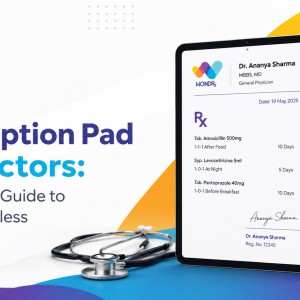
Prescription management and patient record maintenance are essential parts of a doctor's daily responsibilities. In busy outpatient departments (OPDs), doctors handle multiple consultations, prepare prescriptions, document medical information and manage follow-up appointments. Performing these tasks manually can increase administrative workload and make patient record management more challenging.
A digital prescription pad combines handwritten prescription practices with digital record management. It enables doctors to continue writing prescriptions while capturing and converting the handwritten information into digital records. This approach reduces the need for separate data entry and helps maintain organised prescription records.
The WONDRx Smart Rx Kit applies this handwriting-based approach through a smart pen and customised Smart Rx Paper. It captures handwritten prescriptions, converts them into digital records and connects doctors with patients through secure digital links. The system is designed to support existing clinical workflows without requiring doctors to change their usual writing practices.
What a digital prescription pad is (and the three kinds you will meet)
A digital prescription pad is any system that produces the prescription as a digital record, so it can be stored, shared and found again. The category is wide, and the difference that matters most is how the doctor gets the prescription into the system. In practice you will meet three kinds.
The first is typed e-prescription software, where the doctor selects drugs and doses on a screen. It produces clean, structured output and removes any question about legibility, but it charges for that in consult time. The second is the printable template, a formatted prescription pad design that still has to be filled in by hand or typed into a document, and that leaves no searchable record of its own. The third is the handwriting-first smart pad, where the doctor writes on paper as usual and the digitising happens in the background.
Each has a place. The rest of this article focuses on the third kind because it is the one built for the clinic that cannot afford to change how it works.
How a handwriting-first digital prescription pad works
WONDRx is a Mumbai-based health-tech company founded in 2018. Its Smart Rx kit has three parts: custom-designed prescription paper, a digital pen, and the WONDRx Doctor App. The doctor writes on the paper with the pen, and whatever is written is digitised in real time as it is being written. This is the handwritten prescription to digital conversion in a single step, with no typing in between.
On the doctor’s side, tapping the pen on the paper opens a digital image of the prescription in the app, and each medicine appears on that image in the doctor’s own handwriting as it is written. The patient receives a digital copy, which can be shared by SMS along with the clinic’s contact details, location and video references. A Do Not Disturb setting lets the doctor switch the digital features off for a sensitive consult, so the room works like a normal pen-and-paper consultation when it needs to.
Behind the doctor app sits a provider portal for analytics, and a separate patient app where records can be viewed. For the clinic, the practical result is that every prescription written on Smart Rx paper exists twice: once on paper, the way the patient expects, and once as a digital record the clinic can search, reopen and share.
Where the time actually comes back
The honest way to talk about saved time is to say where the seconds go. A handwriting-first pad does not make the consult itself shorter. It removes the tasks that normally get added around it.
During the consult
There is no search box, no dropdown and no confirmation screen. The doctor keeps eyes on the patient and writes, which is the one action that is already as fast as it can be. A digital prescription pad that adds nothing at the moment of writing is, by definition, not slowing the OPD down.
After the consult
A copy does not have to be photographed, forwarded or retyped by staff. It reaches the patient’s phone as soon as it is written, and the clinic’s own copy exists without anyone entering it. A prescription the patient can open on a phone is also one less reason for a pharmacist or a relative to call the clinic and ask what a line says.
At the next visit
A follow-up patient who has lost the slip is a daily event in any OPD. With a digital record, the doctor reopens the last prescription in a few taps instead of asking the patient to remember the medicine that was “the white tablet, twice a day”.
If you want a number rather than an impression, measure it. Time twenty consults on your current system, run a pilot session on the new one, and compare. The result for your clinic matters more than any figure in a brochure.
Managing patient records without building a records department
Here is the less visible problem with a paper pad. A handwritten prescription leaves the clinic in the patient’s pocket, and unless someone copies it, the clinic keeps nothing. The doctor’s memory becomes the record. Audits of Indian prescriptions suggest the paper itself is often thin on detail: in one audit of 2,155 prescriptions at a government medical college in northern India, the patient’s weight was recorded on just 41 of them, about 1.9 percent.
Good patient records need four things. They should be findable by patient, they should show history across visits, they should be shareable with a pharmacy, a lab or a family member, and they should be kept for as long as the rules require. A digital prescription pad that digitises each prescription as it is written gives a clinic the first three almost for free, which is the real argument for clinic digitization in India: not a dashboard, but a record that exists because the doctor did the work they were already doing.
What the rules say about keeping records
The Telemedicine Practice Guidelines of March 2020 require a registered medical practitioner to retain patient records, reports and related data, digital or non-digital, and the official FAQs add that a prescription shared with a patient must be maintained just as it would be for an in-person consultation. Digital signatures are recognised under Section 5 of the Information Technology Act, 2000, which is why a properly signed electronic prescription is accepted for teleconsultations. Check the details with your state medical council, since this is a general summary and not legal advice.
Conclusion
Most digital prescription tools ask doctors to learn something. The ones that last ask for nothing, because the work they replace was already being done: the writing, the copying, the filing, the finding. A digital prescription pad for doctors should make those tasks disappear without adding a new one in their place.
That is the standard WONDRx holds itself to, and it is a fair standard to hold any vendor to. Write the way you write now. Let the handwritten prescription become a digital record on its own. Judge the result by the seconds it costs and the records it leaves behind.
If you want to see how this feels in a real consult, book a WONDRx demo and watch a prescription go from pen to phone, or try Smart Rx in one OPD session and time it against your current routine.