


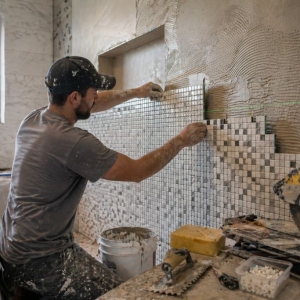





In the design of a home, every material choice carries consequence, but perhaps none is as weighted with implication as the bathroom floor. In regions where humidity is a constant companion and the wet room bathroom is a standard of modern living, this choice becomes a critical juncture between style and security. The elegant, barrier-free expanse of a wet room offers a sense of spaciousness and ease, yet it inherently demands a flooring solution that can defy the very element that defines it: water.
This document outlines a holistic methodology for selecting bathroom flooring. It advocates for an approach that considers environmental factors, human biomechanics, material science, and installation artistry. We will dissect the importance of certified slip ratings, explain the functional geometry of mosaic tiles, and demonstrate how to effectively utilize the resources of a dedicated ceramic tile shop to achieve a result where safety is seamlessly integrated into the design narrative.
Contextualizing the Hazard: The Asian Bathroom Microclimate
The first step in solving a problem is to accurately define it. The Asian wet room is not merely a bathroom that gets wet; it is a microenvironment with its own climatic conditions. High ambient humidity slows evaporation, meaning floors stay damp for longer periods. Frequent use for showering and floor-washing maintains a cycle of wetness. Unlike a shower stall where water is largely contained, here it is distributed across the entire floor area, maximizing the surface of potential hazard.
Crucially, the water is chemically complex. Soaps, oils, and personal care products leave a surfactant residue on tiles. These residues reduce the surface tension of water, allowing it to spread into a thinner, more uniform, and more slippery film. A tile that provides adequate grip under clean water may fail catastrophically under these "in-service" conditions. Therefore, when consulting at a ceramic tile shop, the most pertinent question shifts from "Is this slip-resistant?" to "How is this tile proven to perform under soapy, wet, barefoot conditions?"
Deconstructing Slip Resistance: From Laboratory to Living Space
To bridge the gap between lab data and lived experience, we must understand what the ratings signify.
-
The DCOF AcuTest Value (0.42+): This measures the friction during motion on a wet surface. While 0.42 is a recognized threshold, it represents a minimum for level interior spaces. For the higher-risk wet room, a DCOF of 0.50 or 0.60 indicates a product engineered for greater safety, offering a valuable performance buffer.
-
The R-Rating Scale (R9-R13): Derived from the DIN 51130 test, this rating is earned on an oil-coated ramp. It is a rigorous test of a tile's inherent surface texture. For a bathroom floor where users are barefoot, an R11 rating is the benchmark for true safety, signifying reliable traction on a steep, lubricated incline. An R10 tile may be acceptable in drier perimeter zones, but R9 is fundamentally unsuitable for any wet floor area.
-
The Pendulum Test Value (PTV 36+): This test, which simulates a slipping heel with a swinging rubber arm, is highly predictive of real-world barefoot slip risk. A PTV of 36 is the threshold for low slip potential in public wet areas. For a residential setting where children and elderly may be present, selecting mosaic tiles with a PTV of 40 or higher embodies a commitment to precautionary design.
A comprehensive product specification sheet will list these ratings. Cross-referencing them—favoring tiles that score well across multiple tests—is the strategy of a discerning buyer.
The Ingenious Design of Mosaic Tiles: A Built-In Safety System
While surface texture (micro-texture) is vital, the overall topography of the floor (macro-texture) is equally important. Large-format tiles, for all their aesthetic appeal, create a monolithic plane. When wet, this plane can facilitate hydroplaning, where a thin layer of water completely separates foot from floor.
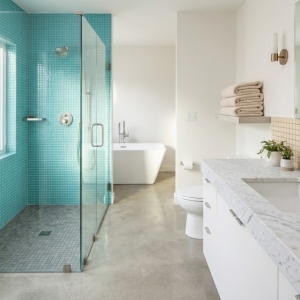
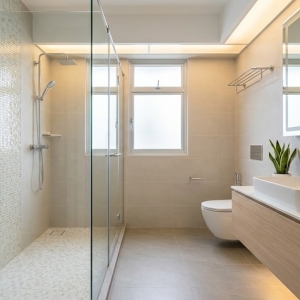
Mosaic tiles, by their very construction, are an antidote to this phenomenon. The assembly of numerous small tiles creates a grid of grout lines. This grid is not a design afterthought; it is a functional safety system:
-
Capillary Action: Grout joints act as a network of tiny drains, drawing water away from the pressure points under the foot via capillary action.
-
Mechanical Lock: The edges of each individual tile create hundreds of minute vertical surfaces. As the soft tissue of the foot deforms on contact, it grips these edges, providing mechanical resistance to lateral movement.
-
Surface Fragmentation: The grid subdivides the water film, preventing it from forming a continuous, unbroken sheet across a large area.
Thus, choosing mosaic tiles for the wet zone incorporates a layer of safety that is geometric and inherent, complementing the chemical and textural properties of the tile material itself. This is a principle well understood by specialists at a professional ceramic tile shop.
A Phased Strategy for Selection and Implementation
Phase 1: Research and Specification.
Begin by gathering technical information. Reputable manufacturers provide detailed datasheets online or through suppliers. Use the ratings (R11, PTV>36, DCOF>0.5) as your initial filter before you even consider color or style.
Phase 2: Sensory Evaluation and Simulation.
Visit a ceramic tile shop with your shortlist. Engage in hands-on testing:
-
The Incline Test: Place a sample tile on a slight angle, pour water on it, and observe. Does the water bead and run off quickly, or does it cling in a sheet? Quick runoff indicates a hydrophobic, safer surface.
-
The Contaminated Grip Test: Apply a soap-and-water solution to the tile. Press the fleshy base of your palm down and attempt to slide it. The force required to initiate movement is a direct correlate of slip resistance.
Phase 3: Systemic Design and Installation Planning.
View the floor as a completed system. Key considerations include:
-
Slope and Drainage: The subfloor must be pitched correctly (a minimum 2% slope is standard) to a sufficiently sized drain. No tile can compensate for poor hydraulic design.
-
Grout as a Component: For mosaic tiles, specify a grout joint width of at least 3mm. Discuss using an epoxy or advanced polymer grout. These materials are more resistant to water absorption, mildew, and staining, ensuring the safety function of the grout grid remains intact and hygienic over decades.
Cultivating a Collaborative Partnership for Success
The path to a perfectly executed wet room floor is collaborative. Your role is to define the safety requirements and aesthetic vision. The role of a knowledgeable ceramic tile shop is to provide options that meet those specifications and to educate you on the pros and cons of each. The installer's role is to translate the materials and specifications into a flawlessly functioning assembly.
Present your plans and concerns to your tile supplier early. A true specialist will appreciate your focus on performance and will guide you toward appropriate product lines, perhaps suggesting a through-body porcelain mosaic with a certified R11 rating and a subtle, stone-like texture. They become a partner in risk mitigation.
In summation, creating a slip-resistant bathroom in a humid climate is a deliberate, knowledge-driven process. It synthesizes an understanding of environmental hazards, a fluency in performance ratings, an appreciation for the safety-engineered mosaic tiles format, and a commitment to quality installation. By adopting this holistic approach, you ensure that your bathroom's most fundamental surface is not its greatest vulnerability, but its most reliable asset—a foundation that offers not just beauty, but profound and enduring peace of mind.