



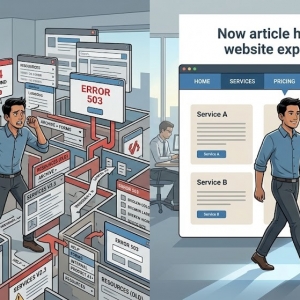








Your website went live months ago. The design impressed everyone at the launch party. Traffic numbers climb steadily each month. Yet your sales team stares at empty inboxes. The contact form hasn't triggered a notification in weeks. Something fundamental is broken, but you can't identify what.
This story repeats across industries and company sizes. Aesthetically pleasing design doesn't automatically create business opportunities. An invisible barrier exists between casual browsers and committed prospects. Usually, this barrier consists of multiple small friction points rather than one catastrophic failure.
Through years of consulting, I've observed this pattern repeatedly. The encouraging news? Rarely does the solution require rebuilding from zero. Often, bringing in a professional web designer to audit and refine your existing site yields dramatic improvements. Sometimes adjusting a single headline or repositioning one button changes everything.
Below are seven critical factors undermining your lead generation, accompanied by specific remedies.
1. Your Message Is Unclear
Human attention spans are brutally short online. Visitors decide within moments whether your site merits further exploration. If your homepage fails to communicate your specific offering and target audience instantly, they vanish. Headlines like "Welcome" or "Quality You Can Trust" sound professional yet convey zero substantive information.
Your value proposition must dominate the initial viewport. Immediately answer: What service or product do you provide? Who specifically needs it? Why is your solution superior? Employ plain, jargon-free language. Verify clarity by testing on friends or family outside your industry. If they require explanation, rewrite relentlessly.
Collaborating with a skilled web designer ensures your message receives appropriate visual emphasis. They understand how layout, contrast, and whitespace direct attention toward what matters most.
2. No Clear Call-to-Action
Visitors need explicit instruction. Without guidance, even interested prospects wander aimlessly and eventually depart. A call-to-action eliminates ambiguity by prescribing the next step: "Book Your Consultation," "Download the Checklist," "Calculate Your Savings."
Position your primary CTA prominently above the fold. Distinguish it visually through bold color choices and generous surrounding space. Select language emphasizing outcomes rather than mechanics. "Get My Free Quote" generates more clicks than "Submit." For lengthy pages, reintroduce the CTA at logical reading intervals.
When you engage a web design company, they apply conversion optimization principles refined across hundreds of projects. They know precisely where prospects hesitate and how to nudge them forward without aggression.
3. Slow Load Times or Poor Mobile Experience
Performance directly impacts profitability. Research consistently shows that pages loading beyond three seconds hemorrhage visitors. Mobile users demonstrate particular impatience. Sites displaying microscopic text, unresponsive buttons, or broken layouts on smartphones appear amateurish and untrustworthy.
Compress images aggressively without quality degradation. Eliminate render-blocking resources. Implement robust caching mechanisms. Critically, evaluate performance on actual mobile hardware, not merely desktop browser emulators. An expert web designer conducts granular speed analyses and resolves server configuration issues invisible to casual observers. Measure everything. Assume nothing.
4. Trust Signals Are Missing
Digital interactions carry inherent risk. Before surrendering contact information, visitors seek evidence of legitimacy. Missing testimonials, absent client lists, invisible security certifications, or no physical address all amplify suspicion and suppress conversions.
Integrate credibility indicators strategically near conversion points. Showcase authentic client success stories with verifiable details. Display professional certifications and industry memberships prominently. Position privacy policy links adjacent to data collection fields. These modest additions dramatically reduce psychological friction.
A seasoned web design company has navigated trust-building across diverse market sectors. They understand which credibility markers resonate with your specific audience and how to weave them naturally into your visual narrative.
5. Poor Navigation or Information Architecture
Cognitive overload destroys engagement. When visitors cannot locate desired information effortlessly, they abandon the attempt. Excessive menu items, ambiguous labels, or contact details buried beneath multiple layers create unnecessary frustration.
Restrict primary navigation to five or seven clearly labeled options. Favor descriptive terms like "Services" and "Pricing" over vague corporate jargon. Embed contact information consistently across headers and footers. Conduct informal navigation tests with individuals encountering your site for the first time. Observe their pathways silently. Confusion points indicate structural weaknesses.
An accomplished web designer treats navigation as functional infrastructure, not decorative afterthought. They organize information according to user expectations and mental models rather than internal organizational charts.
6. Content Doesn't Match Visitor Intent
Traffic quantity means little when quality suffers. Your content may attract visitors seeking solutions you don't provide. Alternatively, it may fail to address the actual questions driving searches. A query for "emergency HVAC repair" landing on your equipment maintenance blog post serves nobody.
Conduct thorough keyword research to understand genuine audience needs. Develop targeted content answering specific questions at each decision stage. A web design company can align page architecture, internal linking, and content hierarchy with these search patterns. Prioritize audience needs over organizational messaging.
7. You're Not Testing or Measuring Anything
Continuous improvement demands data. Without analytics infrastructure, optimization becomes impossible guessing. You cannot distinguish high-performing pages from underperformers, identify abandonment locations, or recognize valuable traffic sources.
Deploy Google Analytics and Search Console immediately. Configure conversion tracking for forms, phone interactions, and resource downloads. Establish monthly review cycles. Hunt for patterns and anomalies. Elevated bounce rates on specific pages suggest content misalignment. Poor mobile conversion rates indicate responsive design failures. Evidence-based adjustments consistently outperform intuition-driven overhauls.
A competent web designer builds measurement frameworks into project foundations. They create reporting structures that transform raw metrics into prioritized action items.
When to Bring in Professional Help
Certain improvements require minimal expertise. Others demand specialized knowledge accumulated through years of focused practice. Technical optimization, structural reorganization, and conversion-focused redesign all benefit significantly from professional intervention.
A web design company contributes systematic methodology to complex challenges. They commence with comprehensive audits, rank opportunities by projected business impact, and execute with precision. Their contribution transcends superficial aesthetics.
When selecting partners, scrutinize their analytical approach. Do they examine your existing performance data before proposing changes? Do they advocate controlled testing over subjective preferences? Do they commit to post-launch measurement and refinement? Exceptional partners approach your website as a revenue-generating business asset.
Start Small, But Start Now
Revolutionary transformation isn't prerequisite for meaningful progress. Select one issue from this inventory that resonates with your current situation. Address it this week. Monitor results. Iterate forward.
Perhaps your headline buries your actual value beneath generic fluff. Rewrite it today. Perhaps your CTA hides at the bottom of lengthy pages. Elevate it. Perhaps your images burden load times unnecessarily. Optimise them. Each incremental victory builds cumulative momentum.
Perfection remains elusive and unnecessary. Consistent progress delivers results. Even marginal lead generation improvements compound substantially over months and years. Concentrate relentlessly on friction elimination rather than feature accumulation. Clarity persuades. Simplicity converts.
Final Thoughts
Lead generation failure rarely indicates fundamental website brokenness. More commonly, it reflects misalignment between your presentation and visitor expectations. Your audience communicates continuously through behavioral data. Your task is interpreting these signals accurately and responding strategically.
Whether pursuing improvements independently or alongside a web designer Singapore, maintain obsessive user focus. Every design element should withstand scrutiny: Does this make positive response easier or harder?
Master the foundational elements first. Unambiguous messaging, compelling calls-to-action, rapid performance, established trust, intuitive navigation, intent-matched content, rigorous measurement. Excellence across these dimensions creates predictable, sustainable lead generation. No magic required. Only methodical execution.