



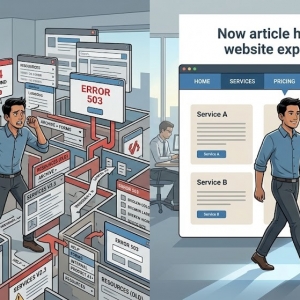







Consider a familiar moment. You follow a search result, land on a page, and nothing happens for several seconds. The content refuses to appear. You close the tab and try a different site. That decision took less than five seconds to make.
Now multiply that single moment by every visitor who encounters the same frustrating experience on your site. The cumulative damage to your business becomes impossible to ignore.
Website speed influences far more than user satisfaction. It shapes purchasing behavior, determines advertising effectiveness, and dictates how visible you remain in search results. A professional who builds websites understands that loading performance sits at the center of every successful digital strategy. Acknowledging this reality equips you to make smarter investments.
The following breakdown explains exactly how slow performance affects your revenue and what to do about it.
The Psychology of Waiting
People browsing the internet operate on a razor-thin margin of patience. Surveys and analytics data consistently indicate that users expect pages to appear within two seconds. Every moment beyond that threshold tests their willingness to stay.
A three-second delay does more than irritate visitors. It plants a seed of doubt. Users begin to wonder whether the site is broken, whether the business is legitimate, or whether submitting their information is even safe. These concerns surface subconsciously but drive real behavior.
Perception shapes reality online. A page that drags signals neglect, even if the delay stems from a minor technical issue. Visitors rarely investigate the cause — they simply leave.
Bounce rates climb proportionally with each passing second of load time. High bounce rates mean fewer people absorbing your message, exploring your products, or entering your sales funnel. The opportunity cost compounds silently with every delayed page load.
How Speed Kills Conversions
Hard data illustrates the stakes with uncomfortable clarity. Major technology companies have published findings showing that a one-second delay in page rendering can reduce conversion rates by measurable percentages. For high-traffic operations, even small percentage drops translate into enormous revenue losses.
A page that requires five or more seconds to load creates a barrier between the visitor and your offer. Potential customers who arrived ready to buy will abandon the process if they cannot access your pricing or checkout within a reasonable timeframe. The product itself never gets the chance to speak.
Lead generation faces the same headwinds. When a prospect clicks through to a contact page and watches a loading indicator spin, their motivation fades quickly. They close the browser and reach out to a competitor instead. Speed does not just affect e-commerce transactions — it shapes every conversion event on your site.
The Hidden Cost to Your Marketing Budget
Paid advertising operates on a simple exchange: you pay for a visitor's attention. If that visitor arrives at a sluggish page and bounces within seconds, you have paid for nothing. The money is gone, and no value was exchanged.
Picture allocating a meaningful portion of your monthly budget to Google Ads. Users encounter your message, click through, and then face a page that stalls for six or seven seconds. That click cost you real money. The visitor never saw your offer. The return on that expenditure is zero.
This pattern repeats across every paid channel. Social media campaigns, email marketing sequences, and display advertising all direct audiences to your website. A web design company attuned to performance recognizes that ad spending and page speed are bound together. When the destination underperforms, the entire promotional effort suffers.
Search Engines Punish Slow Sites
Google has explicitly stated that page speed influences search rankings. The reasoning is user-centered: faster pages deliver better experiences, and Google prioritizes satisfaction. This policy has tangible consequences for businesses that neglect performance.
A slow website cannot rank alongside faster competitors, regardless of content quality. Google interprets speed as a signal of overall site health and user trustworthiness. Falling behind here means losing ground in organic search visibility.
Core Web Vitals represent the specific benchmarks Google uses to evaluate real-world loading behavior. These metrics examine how quickly the main content appears, how fast the page responds to clicks and taps, and whether elements shift unexpectedly during rendering. Sites that miss these benchmarks see their positions drop in search results.
A Singapore website designer who builds with these metrics in mind creates pages that satisfy both users and search algorithms. Reduced visibility in search results translates directly to fewer visitors entering your pipeline, which limits your ability to generate leads and close sales.
Mobile Users Suffer the Most
The shift to mobile browsing is not a trend — it is the current reality. More than half of global web traffic originates on smartphones and tablets. These devices rely on cellular connections that vary wildly in speed and consistency.
Performance benchmarks that look acceptable on desktop often collapse under mobile conditions. A page loading in under two seconds on fiber broadband can easily stretch to eight seconds or longer on a 4G connection. The gap is not marginal — it fundamentally alters how users experience your site.
Google's mobile-first indexing approach means the mobile version of your content determines search rankings across all devices. A website designer who prioritizes responsive performance ensures that pages load quickly regardless of screen size or connection type.
Neglecting mobile optimization does not simply frustrate a portion of your audience. It actively undermines your search rankings, affecting your visibility for every potential customer, no matter how they access the internet.
How to Fix a Slow Website
Addressing load time problems requires a methodical, targeted approach. Some improvements deliver immediate results, while others require more involved adjustments.
- Optimize image files. Heavy visuals are the most frequent culprit behind sluggish pages. Compress images before uploading, use next-generation formats like WebP, and ensure each asset matches the dimensions of its display container.
- Clean up your codebase. Redundant HTML, bloated CSS, and unused JavaScript all contribute to slower rendering. Minify these files, consolidate stylesheets, and defer non-essential scripts to improve initial load times.
- Deploy a Content Delivery Network. A CDN replicates your site's static assets across servers in multiple geographic locations. Visitors receive content from the nearest node, which dramatically reduces latency.
- Evaluate your hosting solution. Budget shared hosting places your site on servers shared with dozens or hundreds of other accounts. Traffic spikes on neighboring sites can degrade your performance. Dedicated or managed hosting provides consistent, reliable speed.
- Trim third-party scripts. Marketing pixels, chat widgets, embedded videos, and analytics tools each add HTTP requests. Audit every integration and remove those that do not justify their performance cost.
Why You Need Professional Help
Simple fixes — reducing image dimensions, clearing browser caches, or uninstalling a redundant plugin — are straightforward tasks. Structural speed problems require diagnostic tools and technical experience that most site owners do not possess.
An experienced website designer approaches performance as a design requirement, not an afterthought. They plan page architecture for efficient loading, write optimized code, and validate performance across a range of devices and network conditions. This foresight prevents the most common causes of slow load times before they take root.
For sites already suffering from entrenched issues, outside expertise offers the most reliable path forward. A qualified web design company conducts a comprehensive audit that maps every bottleneck in your current setup.
The analysis covers server response behavior, database efficiency, asset delivery methods, and front-end rendering logic. Based on these findings, they produce a prioritized plan that addresses the most impactful problems first. Attempting these fixes independently carries the risk of creating new issues while trying to solve existing ones. Professional guidance ensures each change contributes to a faster, more stable site.
The Bottom Line
Loading speed is not a feature you add once your site is "complete." It is a foundational requirement that affects every metric your business depends on.
Each additional second of delay costs you through abandoned purchases, depleted ad budgets, and declining search rankings.
Think of your site's speed as the condition of your welcome mat. A mat that obstructs the entrance discourages people from stepping inside. A clear, inviting threshold encourages exploration.
Start today by testing your site through tools like Google PageSpeed Insights. Establish a baseline and identify where improvements are most urgently needed. If the audit reveals significant problems, a knowledgeable web design company or an experienced website designer can provide the technical roadmap to fix them. The investment in speed optimization pays for itself through higher conversion rates, reduced bounce rates, and a more profitable online presence.