



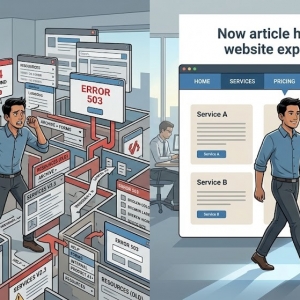







Plenty of contractor sites look polished on the surface yet never convert a single visitor into a paying customer. They crawl along at a snail's pace, bury critical contact details, and present service information like static brochures rather than dynamic lead-generation engines.
If you're running a construction, plumbing, electrical, or HVAC operation, your digital presence isn't meant to be an online trophy case. It's a business tool. Within moments of landing, it must communicate three essentials: What problems do you solve? Which neighborhoods or regions do you cover? What's the fastest way to get a price estimate?
Nail those answers, and your inbox fills with inquiries. Bury them beneath corporate fluff and generic imagery, and prospects vanish before you ever know they existed.
Start with Crystal-Clear Service Descriptions
Nobody cares about your origin story until they've confirmed you handle their exact situation. Your homepage should lead with your primary offerings in plain, jargon-free language.
Do you install roofs, rewire homes, repair furnaces, or unclog drains? Say so immediately. Don't make prospects play detective. Dedicate individual pages to each major trade or specialty.
A panicked resident typing "water heater leaking at midnight" won't patiently read a broad "services overview" paragraph. They'll scan for plumbing or HVAC, click the relevant page, and hunt for a phone number they can dial right now.
Keep every service page tightly scoped. Detail what you handle, what you refer elsewhere, and how long typical jobs take. Explicit boundaries set realistic expectations and screen out time-wasting inquiries before they consume your morning.
Prove Your Credibility Upfront
Reputation is currency in the trades. Your site must establish legitimacy before any prospect will share their contact information or invite you onto their property.
Prominently display state license numbers, general liability coverage, workers' compensation details, and relevant certifications. Position these trust signals near the top of service pages or in a sticky sidebar—not exiled to the footer where few scroll.
Replace stock photography with genuine project documentation. Show actual completed work, messy mid-project stages, and your real team members in action. Add concise captions identifying the job location and work performed.
Rather than posting self-selected testimonials, direct visitors to verified third-party review platforms. Google reviews, BBB ratings, and industry-specific directories hold substantially more persuasive power than curated praise hosted on your own domain.
Credibility isn't asserted through bold claims. It's demonstrated through evidence that prospects can independently verify within seconds.
Streamline Every Path to Contact
Each additional form field shaves percentage points off your conversion rate. You don't need a comprehensive intake survey merely to open a dialogue.
Request name, phone, email, service category, and a brief project summary. Photo uploads can be helpful but should remain strictly optional.
Your phone number and a bold "Request Estimate" button belong in the persistent site header, visible across every page. Mobile visitors will tap-to-call instinctively. Office-based prospects may prefer the form. Both experiences must be instantaneous and reliable.
Audit your own contact process from a smartphone. If the form hangs, refreshes unexpectedly, or takes longer than a few heartbeats to process, repair it immediately. Qualified leads have zero patience for technical friction.
Design for Mobile Users First
Approximately half your traffic originates from phones and tablets. Frequently these visitors are standing on active job sites, idling in supply house parking lots, or troubleshooting issues mid-project from their work vehicles.
Your site has no more than three seconds to fully render on standard cellular connections. Compress all imagery before upload. Adopt modern formats like WebP. Purge autoplay videos and resource-heavy carousel sliders.
Such elements exhaust device batteries, obscure content, and delay access to your contact information. Embrace clean layouts, readable font sizes, and breathable spacing.
If navigation feels cramped or overwhelming on a five-inch screen, you're hemorrhaging potential bids. Performance isn't a technical luxury—it's a conversion prerequisite.
A lagging website implicitly tells prospects that their time matters less to you than your own convenience, regardless of how exceptional your fieldwork may be.
Dominate Your Local Search Territory
Contracting is geography-bound. If search engines can't determine your service radius, you'll compete against distant competitors for leads you can never realistically serve.
Publish your service areas explicitly. Generate location-specific landing pages exclusively for zones where you actually dispatch crews.
Maintain perfect consistency in business name, street address, and phone number across your website, Google Business Profile, Yelp, Angi, and every other directory. Maps can supplement contact details but must never substitute for them.
Effective local SEO avoids keyword stuffing. Instead, it depends on NAP consistency, accurate service categorization, and authentic project documentation that mirrors real customer search behavior.
When a prospect searches "commercial roofing contractor near [city]," your site should surface with a precisely matched service page and a functional click-to-call number.
Pitfalls That Sabotage Lead Generation
Several common practices silently strangle your bid pipeline. Concealing phone numbers behind nested menus or burying contact links in obscure dropdowns forces prospects to work harder than necessary.
Ambiguous pricing references like "contact us for rates" without any framing context lead visitors to assume premium pricing or bureaucratic hassle.
Elaborate animations and cinematic page transitions might dazzle in a design showcase, but they impede decision-making and distract from your core objective.
Maintain ruthless functional focus. Eliminate any element that doesn't directly help visitors understand your capabilities, validate your trustworthiness, or initiate contact.
If a section serves no purpose beyond occupying space, delete it without hesitation.
Recognizing When Expert Assistance Pays Off
DIY website builders can produce functional starter sites, but sustainable lead generation demands structural sophistication. A seasoned website designer grasps how to organize service hierarchies, implement event tracking, and calibrate form layouts for mobile conversion.
They'll also address critical technical foundations: server response optimization, structured data markup, semantic heading architecture. These invisible elements influence search visibility far more than most trade owners assume.
As volume increases, engaging a dedicated web design company delivers measurable returns. They'll synchronize your digital infrastructure with operational workflows, embed customer relationship management tools, and configure analytics dashboards revealing which pages genuinely produce revenue.
Avoid investing in visual spectacle. Allocate budget toward logical information architecture, blistering load speeds, and contact pathways that never fail. A capable website designer optimizes for measurable outcomes, not superficial impressiveness.
When evaluating a web design company, demand portfolio examples from comparable trade clients. Seek quantifiable proof: reduced bounce rates, increased quote requests, elevated local pack rankings. Relevant sector experience prevents costly trial-and-error and accelerates results.
The Bottom Line
A trade contractor's website needn't dazzle design critics. It must answer urgent questions, substantiate qualifications, and minimize friction toward engagement. Concentrate on explicit service definitions, verifiable trust signals, effortless contact mechanisms, and geographically precise visibility. Strip away ornamental excess. Measure conversion metrics. Iterate when response rates soften.
Whether you retain a website designer or maintain the site personally, never lose sight of the visitor's perspective. Every click should advance them toward scheduling your services.
When your digital presence operates with the reliability of your best crew leader—direct, systematic, perpetually available—project bids accumulate naturally. And when expansion demands a more robust platform, a web design company steeped in construction industry knowledge can elevate your presence without discarding proven foundations.