






Introduction
Artificial intelligence is advancing at a pace few industries predicted a decade ago. From intelligent chatbots and recommendation engines to autonomous AI agents and enterprise automation, machine intelligence is becoming deeply embedded in modern business ecosystems.
Yet behind these impressive breakthroughs lies a lesser-discussed reality. AI systems do not become intelligent simply because of larger models or faster computing power. Their effectiveness depends heavily on the quality of the data they learn from.
This is where AI text data collection is quietly reshaping the future of machine intelligence.
In 2026, organizations are increasingly realizing that building smarter AI systems requires more than sophisticated algorithms. It requires scalable, diverse, and context-rich data capable of helping machines understand how humans communicate, reason, and make decisions.
The shift toward data-centric AI is redefining how intelligent systems are trained and deployed. As a result, AI text data collection is becoming one of the most valuable foundations of modern machine learning.
Why Is Data Becoming More Important Than Models?
For years, AI innovation focused primarily on model architecture and computational power. Companies competed to build larger systems with more parameters and faster processing capabilities.
However, the industry is experiencing a major shift.
Many AI experts now believe that better data often creates stronger performance improvements than larger models alone.
The reason is simple.
Machine intelligence depends entirely on learning patterns from data.
If training data contains:
- Inaccuracies
- Bias
- Poor context
- Limited diversity
- Outdated information
the resulting AI system struggles to deliver reliable outputs.
This growing realization is pushing businesses toward data-first AI strategies.
AI text data collection sits at the center of this transformation.
What Is AI Text Data Collection?
AI text data collection refers to gathering, organizing, validating, and preparing textual information for machine learning and AI model training.
These datasets may include:
- Customer conversations
- Emails and documents
- Product reviews
- Online discussions
- Knowledge bases
- Research papers
- Enterprise communication data
The objective is not simply collecting large volumes of text.
The goal is building high-quality and context-rich datasets that help AI systems understand language more naturally.
This process has become increasingly important as generative AI and intelligent automation continue expanding across industries.
How Is AI Text Data Collection Powering Machine Intelligence?
Machine intelligence relies heavily on language understanding.
AI systems must learn to:
- Understand meaning
- Detect intent
- Interpret tone
- Process context
- Generate relevant responses
AI text data collection supports these capabilities by exposing models to real-world communication patterns.
This improves:
Conversational Intelligence
AI assistants and chatbots require diverse language datasets to deliver natural conversations.
Decision-Making
Contextual text data improves reasoning and business logic.
Personalization
AI systems learn user preferences and communication behavior.
Knowledge Retrieval
Intelligent systems can search and summarize information more effectively.
The result is smarter and more adaptive AI systems.
Why Is Training Data Collection for AI Becoming a Strategic Priority?
The quality of AI systems depends heavily on the datasets used during training.
This is why Training Data Collection for AI has become a major business priority.
Organizations are investing heavily in:
- Domain-specific datasets
- Real-time information streams
- Multilingual content
- Industry-focused knowledge repositories
Training Data Collection for AI enables businesses to:
- Improve model accuracy
- Reduce hallucinations
- Increase scalability
- Build reliable enterprise AI solutions
Static datasets are no longer sufficient for modern AI systems.
Continuous and scalable data collection has become essential.
How Do AI Data Annotation Services Improve AI Accuracy?
Raw data alone cannot train intelligent systems effectively.
Data must be labeled and structured before machine learning models can interpret it properly.
This is where AI Data Annotation Services play a critical role.
Annotation helps AI systems understand:
- Intent
- Categories
- Relationships
- Semantic meaning
- Contextual relevance
AI Data Annotation Services improve machine intelligence by making training datasets more precise and actionable.
Examples include:
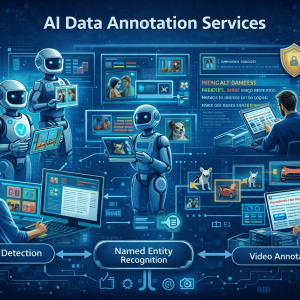
- Named entity recognition
- Sentiment tagging
- Intent classification
- Context labeling
Businesses increasingly combine AI text data collection with annotation strategies to build more dependable AI ecosystems.
Why Are Image and Video Annotation Services Relevant to Text-Based AI?
Modern machine intelligence is becoming multimodal.
This means AI increasingly learns from:
- Text
- Images
- Video
- Audio
Although text remains central, Image Annotation Services and Video Annotation Services are becoming increasingly important.
Image Annotation Services help AI systems:
- Recognize objects
- Understand visual context
- Improve computer vision accuracy
Video Annotation Services support:
- Motion analysis
- Activity recognition
- Scene understanding
- Behavioral detection
When combined with AI text data collection, these services help create more intelligent and context-aware AI systems.
For example, an AI assistant may use:
- Text understanding
- Image recognition
- Video analysis
to interpret real-world situations more accurately.
This integrated approach is shaping the next generation of machine intelligence.
How Is AI Data Collection for Healthcare Driving Innovation?
Healthcare represents one of the fastest-growing AI sectors.
AI Data Collection for Healthcare is transforming how medical systems operate and make decisions.
Healthcare AI depends heavily on:
- Clinical records
- Medical documentation
- Research literature
- Patient communication data
AI text data collection supports healthcare innovation by helping systems:
- Analyze medical language
- Identify patterns
- Improve diagnosis support
- Automate documentation
- Enhance patient engagement
AI Data Collection for Healthcare demonstrates how specialized datasets can produce highly valuable AI outcomes.
As healthcare AI expands globally, the demand for domain-specific text data continues growing rapidly.
Why Is Real-Time AI Text Data Collection Becoming Essential?
Traditional machine learning relied on fixed datasets collected months or years earlier.
This approach is becoming outdated.
Modern AI systems increasingly depend on real-time intelligence.
Real-time AI text data collection enables systems to learn from:
- Live conversations
- Current trends
- Market changes
- User behavior
- Dynamic workflows
This improves:
Adaptability
AI systems respond to changing environments.
Relevance
Models remain current and useful.
Performance
Continuous learning strengthens accuracy.
The move toward real-time data pipelines represents one of the biggest shifts in AI development.
What Challenges Still Exist in AI Text Data Collection?
Despite rapid innovation, challenges remain.
Data Quality Problems
Low-quality text reduces AI reliability.
Bias and Representation
Unbalanced datasets may create unfair outcomes.
Privacy and Compliance
Organizations must protect sensitive information.
Scalability
Managing large datasets requires strong infrastructure.
Validation Complexity
Ensuring accuracy across global datasets is demanding.
Addressing these issues requires strong governance and well-designed data strategies.
Businesses increasingly invest in professional data infrastructure to manage these challenges effectively.
Why AI Text Data Collection Is Quietly Defining the Future of AI
Artificial intelligence is entering a new phase.
The future of machine intelligence depends less on building the largest models and more on creating the strongest data foundations.
AI text data collection enables systems to:
- Learn human communication
- Improve contextual understanding
- Adapt continuously
- Deliver reliable outcomes
When supported by:
- AI Data Annotation Services
- Image Annotation Services
- Video Annotation Services
- Training Data Collection for AI
- AI Data Collection for Healthcare
organizations gain access to more intelligent and scalable AI ecosystems.
This shift is happening quietly but powerfully.
The companies investing in smarter data pipelines today are positioning themselves as the AI leaders of tomorrow.
Final Thoughts
AI innovation is no longer driven by algorithms alone. The industry is moving toward a future where data quality defines machine intelligence.
AI text data collection is quietly reshaping this future by helping AI systems understand language, context, and human behavior more effectively.
As machine intelligence becomes increasingly autonomous and enterprise-driven, organizations must focus on building scalable, ethical, and context-rich datasets.
The future belongs to businesses that recognize one important truth — smart AI begins with smarter data.
FAQs
Why is AI text data collection important for machine intelligence?
It provides the language and contextual foundation that helps AI systems understand and communicate more effectively.
How do AI Data Annotation Services improve AI models?
They label and structure datasets, helping AI systems interpret meaning and context accurately.
Why are Image Annotation Services and Video Annotation Services relevant to AI?
They support multimodal AI learning by helping systems understand visual information alongside text.
What is Training Data Collection for AI?
It involves gathering and preparing datasets used to train machine learning and AI systems.
How is AI Data Collection for Healthcare improving medical AI?
It supports medical language understanding, documentation automation, and better healthcare decision support.