



As It Happens6:31U.K. government moves to ban inflated resale of tickets for entertainment and sports events
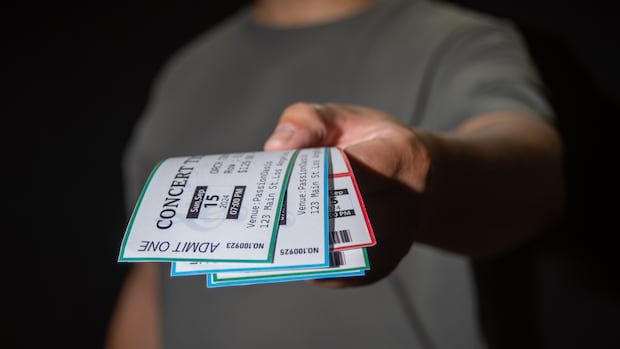
Whether you're vying for seats at a Toronto Blue Jays playoff game or frantically refreshing screens for a shot at Taylor Swift’s blockbuster Eras Tour, the heartbreak has become all too familiar: tickets vanish within minutes, only to resurface on resale sites at much more than their original price.
But the U.K. government is moving to crack down on the reselling that prices fans out of seeing their favourite artists and teams. The proposed legislation, announced on Wednesday, would make it illegal to resell tickets for concerts, theatre, comedy, sports and other live events for more than their original face value.
“For too long, ticket [scalpers] have ripped off fans, using bots to snap up batches of tickets and resell them at sky-high prices,” Lisa Nandy, British Secretary of State for Culture, Media and Sport said in a statement.
This move follows a call from musicians last Thursday, where artists including Coldplay, Dua Lipa and Radiohead, urged British Prime Minister Keir Starmer to crack down on “extortionate and pernicious” websites that resell concert tickets.
According to the U.K. government, the measures could save fans there around £112 million annually ($206 million) and result in 900,000 more tickets being purchased directly from primary sellers each year.
In the U.K., the secondary ticket market is dominated by Viagogo and StubHub. There, Ticketmaster previously ran its own resale sites, Get Me In! and Seatwave, but it since switched to a capped resale platform.
Adam Webb of the London-based Fan Fair Alliance, a group campaigning against online scalping, say the regulation could directly target the nefarious behaviour of scalpers.
"You've got some dedicated people unlawfully removing huge volumes of primary tickets at face value and then instantly [and] dynamically inflating those tickets,” Webb told As It Happens host Nil Köksal.
"They are creating their own demand, and then they are 'very kindly' offering to fulfill that demand.”
The new rules, will apply to all platforms that sell tickets to U.K. fans — including social media such as Facebook Marketplace or X. Businesses that break the rules could face financial penalties.
Small and big events affectedScalping affects events of all sizes, says Webb. For major shows, he's seen scalpers focus on maximizing profit, often driving ticket prices to extreme levels. Yet he says many of their strategies don’t always make sense.
"Why would you be pricing yourself out of the market by listing tickets at £10,000 ($18, 439)?” Webb said.
 Adam Webb and his FanFair Alliance campaign are against the online scalping industry because it drives up prices and shuts out real fans. (Rachel Houlihan/CBC)
Smaller venues are not immune. Webb said he found tickets for a Steely Dan cover band, priced at £22 ($40.57), were being resold by a single seller for up to £129 ($237.87) each, with another two tickets listed for £5,394 ($9946.24).
While the government’s proposal may feel like “a real champagne moment,” Webb cautions it is “not quite a victory yet” until it becomes law.
“The ultimate ambition is a change of market," Webb said.
What this means in CanadaVass Bednar, managing director of a policy think tank called Canadian Shield Institute, says it's “encouraging” that the U.K. government is responding to public frustration and framing it as a cost-of-living policy issue.
In general, she says the U.K. is further along in debating acceptable ticket-pricing practices.
For example, Britain’s competition watchdog launched an investigation into Ticketmaster last year over the sale of Oasis tickets, including the use of "dynamic pricing" to hike the cost to fans at the last minute.
Many thought they would pay the advertised rate of £148.50 ($264) but ended up paying more than double at £355.20 ($632).
WATCH | Canadian experts weigh in on U.K. ticket scalping ban:Proposed new laws in the U.K. would ban the resale of a ticket above face value. Advocates say it will level the playing field for fans, but resale companies say the move will fuel black markets.Canada “has an aversion to any kind of market intervention,” said Bednar, even though the resale market is far from free. Fans, she says, are often locked out of initial sales and then exploited by inflated resale prices, with Ticketmaster controlling prices and bots scooping up tickets.
In October, Ticketmaster vowed to crack down on scalpers following a U.S. Federal Trade Commission lawsuit filed in September.
However, music industry expert Eric Alper is less optimistic about the U.K. government's proposed regulation. He warns that capping ticket resale could have unintended consequences.
"What this is going to do is drag those tickets into the underground and through Facebook and X and through direct messages. There's no law that's going to protect you from something like that,” Alper said.
More than policyWebb urged the public to pressure their MPs in the U.K. to include the legislation in the upcoming King’s Speech cycle, allowing progress as early as next spring. If delayed, he says the process could be stalled for years, prolonging exploitation and siphoning money from fans and the creative economy.
"We’re talking about hundreds of millions of pounds which is being displaced from the back pockets of fans to offshore websites,” Webb said.
For Bednar, she's disheartened to see that costly ticket prices are taking away what has long been a shared cultural experience — citing how sporting events like Blue Jays and Toronto Raptors games have become increasingly out of reach for average Canadian families, erasing the accessible, nostalgic moments that many once enjoyed.
“I think part of being a member of society is being able to enjoy sports and concerts and not have them feel like they're the equivalent of a mortgage payment or something like that,” she said.