








Cadence Wille comes from a family steeped in car and motorsport culture. Her maternal grandfather was an automotive technician. Her dad’s family ran a classic car museum and racetrack. But she didn’t start watching Formula One until 2020. And once she did, she was hooked.
"Instantly," said the 26-year-old F1 content creator based in Victoria.
"It wasn’t just the track action that was exciting, but realizing that so much goes into the car development, the rules are so intricate — just everything about it."
In Canada and the U.S., F1 has gone from niche motorsport to mainstream obsession in just a few years, thanks in large part to the Netflix documentary series Drive to Survive.
 Cadence Wille started watching F1 in 2020 and posting content in 2024. (Submitted by Cadence Wille)
It's become a global entertainment powerhouse, lifestyle brand and pop culture phenomenon — a shift driven in part by a new wave of content creators like Wille championing the sport online. They post memes and race reactions, dig into the lore and help explain the sport's rules to new fans.
Wille started making content in 2024 under the handle @cadencebraking. She now has more than 100,000 combined followers on Instagram and TikTok.
"So much of the social media landscape in F1 — there’s a lot of women in that space," she said.
"It’s also giving all of the professionals in motorsport, all of the women working in motorsport, another place to talk about their jobs and their journey."
Tiggy Valen, a California-based F1 content creator and host of the Paddock Project podcast, started making content in 2022 — what she calls starter-pack, 101-type explainer videos. At the time, she said, almost everything else was highly technical, inaccessible to new fans and fronted by British men over the age of 40.
“The goal was to build this educational on-ramp for people,” she said.
“How do I sit down and watch a Formula One race for the first time? When people are saying DRS [drag reduction system], what does that mean? Or how many people are actually working on the car and in what capacities?”
Valen’s second goal? Bring fans together.
“When people were becoming Formula One fans in the U.S. in the early 2020s, there was no real community around it,” she said.
“We wanted to create a community of mostly women who enjoyed the sport and didn’t really have a lot of people in their lives to talk to about it.”
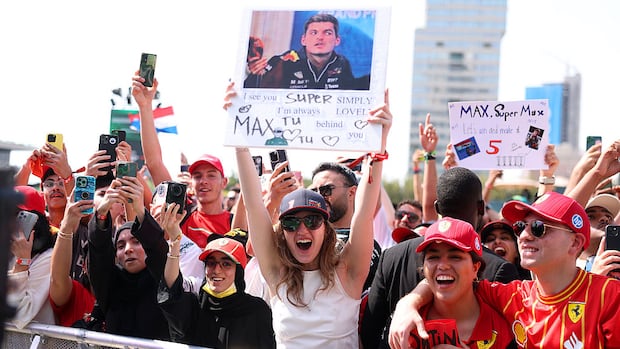
Now it's one of the fastest-growing sports in the world, and its fan base is younger and more diverse than ever: 42 per cent of fans now are under 35 and 41 per cent are women. What's more, female fans now account for three out of every four new fans.
“We went from it being a stuffy, old rich white guy sport, to it being one of the most eclectic fan bases of any sport anywhere,” said James Hinchcliffe, a Canadian racecar driver and analyst for F1TV.
The six-time IndyCar winner isn’t just surprised by how much F1’s audience has transformed, but rather how quickly it’s happened given the sport’s 75-year history.
 James Hinchcliffe, Canadian racecar driver and analyst for F1TV, says the sport now has one of the most eclectic fan bases. (Alex O'Connor)
"I'm not even sure how much of this was done with a conscious, 'Hey, how do we make this more appealing to the female demographic?' … I think that people just say, 'Hey, this is an exciting, fascinating kind of different thing that I hadn’t really thought about before.'"
That new fan base has changed the sport dramatically, pushing the once-secretive and male-dominated world of F1 to be more accessible and open than it's ever been.
"For a long time in Formula One, there was no interaction with the outside — it was very closed. You could only see it on TV," said Bernie Collins, an analyst for Sky Sports F1 and former head of race strategy for the Aston Martin F1 team.
"Now they’ve done the best, I think, with social media interaction, with short clips, with trying to get short-form content out there that people can consume really easily."
 F1 analyst Bernie Collins attends the launch of the McLaren Artura Spider in London on May 14, 2024. (Jeff Spicer/Getty Images for McLaren Automotive Limited)
Today's drivers bare their abs on the cover of British Vogue and talk openly about mental health. When he’s not on the racetrack, reigning World Drivers' champion Max Verstappen runs a popular Twitch channel with 477,000 subscribers. Seven-time world champion Lewis Hamilton has established himself as a celebrity and fashion icon, securing brand deals with Lululemon and Dior.
"It's pretty impressive what F1 and [parent company] Liberty Media have managed to do, and how they’ve managed to really embrace the online side of things and content creator culture," Hinchcliffe said.
 Lewis Hamilton, seen here at the paddock before a final practice in Mexico in October, has become a fashion icon. He's known for bringing fashion to the racetrack. (Hector Vivas/Getty Images)
It also means F1 has become big business. Now the average team is worth more than $5 billion Cdn. Even Alpine, the worst-performing team of 2025, is worth more than $3 billion — nearly double what it was in 2023.
“It’s shown in the data that women have more purchasing power,” Valen said. “They’re showing up not only with energy and passion, but they’re also buying the merch.”
 Tiggy Valen, pictured at the Dutch Grand Prix in August, says F1's new fan base is holding the sport accountable in a way it hasn't been before. (Submitted by Tiggy Valen)
And the sport has taken notice. Teams are partnering with beauty brands like Charlotte Tilbury and Elemis — the kind of sponsorships traditionally dominated by big tech and betting firms.
"It's helping shift where the money is coming from in Formula One," Valen said. "It's helping shift the perception that only certain types of people or brands belong in the sport."
That new audience wants more than just fresh sponsorships and fan events; they want to see themselves reflected in the sport, too.
Gone are the days when so-called "grid girls" walked the racetrack (a custom that ended in 2018). Women are making their mark across the sport, taking on more high-profile, technical positions within F1 teams — jobs that were traditionally held by men.
"There are so many women in the crowds — and then you see them on the pitwall and in the garages," Wille said. "You hear them in the broadcast, women like Bernie Collins and [engineer and F1TV presenter] Ruth Buscombe, who have come from these very prestigious roles in Formula One."
 Laura Mueller, race engineer of Haas F1, looks on during practice ahead of the Grand Prix of Mexico at Autodromo Hermanos Rodriguez on Oct. 24 in Mexico City. (Peter Fox/Getty Images)
Laura Mueller became F1's first female race engineer when she was appointed by Haas in early 2025. Red Bull principal strategy engineer Hannah Schmitz recently stood atop the podium alongside driver Max Verstappen when he clinched an unlikely win, thanks to her call from the pitwall.
And in 2022, F1 launched F1 Academy, an all-female Formula 4-level racing series led by former professional racing driver Susie Wolff. All 10 F1 teams now each sponsor one F1 Academy driver. (Another docuseries, produced by Reese Witherspoon's production company, that follows those drivers launched on Netflix earlier this year.)
Women now make up 38 per cent of the sport’s workforce, up from 28 per cent in 2017. However, they still make up a higher percentage of the lowest-paying jobs (53 per cent) than at the highest-paid positions (31 per cent).
Still, Valen thinks the shifting fan demographic is helping to move the representation mark.
"I think fans — especially newer fans and especially female fans — are making their voices heard,” she said. "I think they're holding the sport accountable in a way that it really hasn't been held accountable in the past."
 Max Verstappen, left, and Hannah Schmitz celebrate on the podium at Lusail International Circuit in Qatar on Nov. 30. (Mark Thompson/Getty Images)