

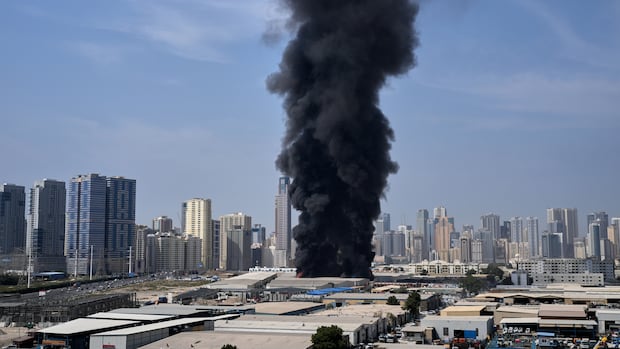
Blanka Calibaba, a Canadian who has been in the United Arab Emirates for the last 13 years, starts to explain what it's like living in the middle of an air war when a government text interrupts her train of thought.
"Right now, I'm seeing a message on my phone: 'Due to the current situation, potential missile threats. Seek immediate shelter in the closest secure building and to steer away from windows, doors and open areas,'" she said.
Calibaba says that when Iran began targeting Persian Gulf states on Saturday, the U.A.E.'s emergency mobile alert system was sending her regular warnings. Since then, they have been less frequent.
On Tuesday, she received three government warnings, she said. When they arrive, she stays away from the window of her apartment in Abu Dhabi and takes shelter in a room where she can close the door. When the threat passes, she gets another text message.
Over the past week, the Grade One teacher says she has come to recognize the sound of a missile being blown up, and it no longer worries her.
"I feel like even though right now, we're in an unfortunate situation, the government is working very hard to keep us safe," she said. "And if you read the numbers, how many missiles they took down, it's incredible."
The only real threat she is worried about, she says, is being hit by falling debris once a missile has been taken out. But as long as she's indoors, she feels safe.
 Canadian Blanka Calibaba, a Grade One teacher in the United Arab Emirates, has been living in the Persian Gulf state for 13 years. (Submitted by Blanka Calibaba)
Allison Furlong, from St. Brendan's, N.L., shared a similar experience from Qatar.
"There's been lots of missiles, but they've been intercepted," Furlong said. "Initially, there were missiles being intercepted almost on the hour … you would hear loud noises, loud booms overhead."
Furlong has lived in the capital of Doha for the past 12 years. She describes it as a place so safe people do not lock their doors and can be assured if they leave their wallet or purse somewhere, they can return hours later to find it untouched.
Routine of life under siegeSince Iran started targeting U.S. military assets in the country following American and Israeli airstrikes, Doha has continued to operate with what Furlong describes as a "COVID-19 vibe," where foot and vehicle traffic are dramatically reduced and retail outlets remain open with restrictions.
Those booms overhead have almost become routine.
"It's crazy how you can sort of just become somewhat used to it," she said. "Every noise that you hear, you kind of stop and you think, "Oh, is that a missile?' You're always kind of on alert, you know, but the first couple of days were the worst."
 Allison Furlong lives in Doha, which she describes as a place so safe people do not lock their doors. (Submitted by Allison Furlong)
Global Affairs Canada (GAC) said that as of Monday, the number of Canadian citizens registering their presence in the Middle East increased to more than 97,000 from 85,000 the previous day.
The U.A.E. has registered the most Canadians, at almost 25,000, while Qatar has just over 8,000, according to GAC. Some are tourists travelling through while others are expats now living in the Gulf, such as Calibaba and Furlong.
Lynn Murphy-Kaulbeck, a doctor from Halifax, landed in Dubai on Feb. 26, after spending several weeks vacationing and visiting with friends in Kenya. She and her husband were scheduled to fly back to Canada on Saturday. Their flight was cancelled.
She says that when she gets one of the U.A.E. government alert messages on her phone warning of an impending missile, she knows there's nothing she can do but rely on the country's air defences.
She is trying to find a flight out of the country amid cascading cancellations. She is now on her fifth booking, set for departure on Thursday which will take her through Boston instead of directly back to Canada.
"I think if it doesn't go Thursday, then we'll kind of say: 'OK, what else? What other options do we have?'" she said.
Trapped with no good optionsCBC News initially spoke with Murphy-Kaulbeck on Tuesday. She said Wednesday morning that loud booms could be heard in the sky overnight which lit up the horizon. She says her biggest worries now are what's going to happen next and how far the war could escalate.
The associate professor specializing in maternal fetal medicine at Dalhousie University says consular officials gave her a list of suggested land crossings so she could get into Oman, where, she was told, flights are still operating.
 Dr. Lynn Murphy-Kaulbeck, shown here in 2017, says she has heard large booms overhead since Saturday but feels reassured by the success of the U.A.E.'s air defences. (CBC)
Sylvie Thompson and her husband arrived in the U.A.E. from Montreal Feb. 22. They came to visit their seven-month-old grandchild and spend time with their son who lives and works in the country but are now stuck.
They have been staying at Dukes The Palm Dubai hotel, a 10-minute walk from the Fairmont The Palm hotel that was hit by an Iranian missile over the weekend.
Thompson says that life after the weekend barrage of missiles is becoming more routine, with stores reopening, traffic resuming and some people even heading back out to enjoy the weather. But with the airspace closed and her flights cancelled, she says, she is running low on her Crohn's medication.
"It's making me feel unnerved, overwhelmed, anxious," she said. "It definitely affects your mental health as well because it's constantly on your mind and you hear the booms, you see people sheltering.
"If you talk to people around the hotel, they pretty much have the same problem … they cannot get out."
Travellers who spoke to CBC News say they are caught in a region of the world with no safe exits. And if they stay in the Persian Gulf, they risk being there if and when the conflict escalates.
If they do get a flight, they say they're worried how safe it will be to fly in an airspace littered with missiles, drones and anti-missile batteries.
Whether living in the Gulf or travelling through, concern over what is going to happen next is what binds them together.