



Listen to this article
Estimated 4 minutes
The audio version of this article is generated by AI-based technology. Mispronunciations can occur. We are working with our partners to continually review and improve the results.
Witnesses before a House of Commons committee Thursday say they fear "legislative extinction" of their First Nations if the federal government does not eliminate the Indian Act's second-generation cut-off.
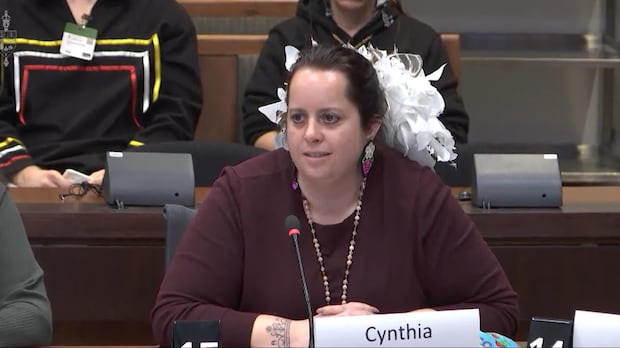
Cynthia Lapierre, a member of the Wendat Nation in Quebec, told the committee they are "facing extinction head on" in the next 50 to 70 years, due to the cut-off.
"History is repeating itself. There are children in our communities that are ghosts. They have no rights or recognition or belonging," said Lapierre, comparing them to the women who lost Indian status for marrying out under the Indian Act prior to 1985.
Lapierre, who addressed the committee as an individual and not as a representative of Wendat Nation, said about 87 per cent of Wendat Nation's 5,500 members who are under the age of 39 are registered under Section 6(2) and affected by the second-generation cut-off.
This means one of their parents does not have Indian status, and if they have children with a non-status partner, they can't pass status on to their children.
"Let's not forget when and why [6(2)] was created," she told the committee.
"With Bill C-31 in 1985 some women and their children regained their rights so the Indian Act had to adapt to uphold its objective of genocide — give women and children their status while introducing a second-generation cut-off. It's working."
Bill S-2 was introduced to the Senate last year to address outstanding issues with the Indian Act related to enfranchisement, as determined in the British Columbia Supreme Court case Nicholas v. Attorney General (Canada).
The Senate amended the bill to end the second-generation cut-off, passed it in December and sent it on to the House of Commons. It is currently being studied by the Standing Committee on Indigenous and Northern Affairs.
A brief by the Council of the Wendat Nation submitted to the Senate last year stated within a few generations, "up to 40 per cent of the Wendat Nation's population could find themselves unable to have descendants registered under the Indian Act," due to the second-generation cut-off.
Hayden Guilderson, a councillor for Tzeachten First Nation in B.C., expressed similar views.
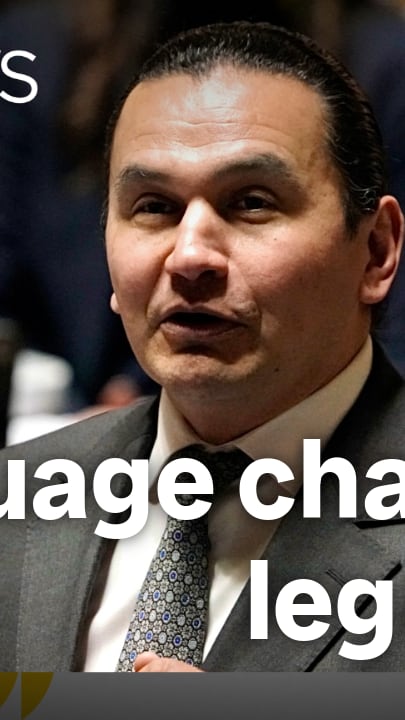
 Hayden Guilderson, a councillor for Tzeachten First Nation in B.C. says his nation faces 'legislative extinction' within a few generations due to the second-generation cut-off. (ParlVu)
"Tzeachten is currently facing a risk of legislative extinction, not because our people are disappearing, but because of federal law narrowing who counts," Guilderson told the committee.
Guilderson said of Tzeachten First Nation's 612 status members, about 31 per cent are registered as 6(2) and directly impacted by the second-generation cut-off.
Guilderson said his own kids do not have status due to the second-generation cut-off, even though they are recognized as Tzeachten members.
"That is the disconnect that we're asking Parliament to address," he said.
"The current federal system is creating a separate and shrinking definition of our people each generation. More of our members risk being recognized by Tzeachten, but not by Canada."
The committee has heard from more than 40 witnesses so far during its study of Bill S-2. Some First Nations leaders oppose Bill S-2, saying the bill perpetuates federal government control over defining identity.
Indigenous Services Canada has said more consultations are needed on eliminating the second-generation cut-off and how that will impact First Nations.
Canada recently requested the B.C. Supreme Court extend the suspension of its ruling on the Nicholas case to allow more time to pass Bill S-2.
In the committee meeting Thursday, Assembly of First Nations National Chief Cindy Woodhouse Nepinak said the federal government must move forward "without hesitation."
"First Nations have been consulted on this question of status and of citizenship since at least 1985," Woodhouse Nepinak said.
"It is the federal government that has legislated Indigenous identity in the first place, and the federal government must take responsibility for discrimination under the legislation. First Nations are ready to move forward."