

Unreserved50:29Mother’s day stories of strength and cultural reconnection
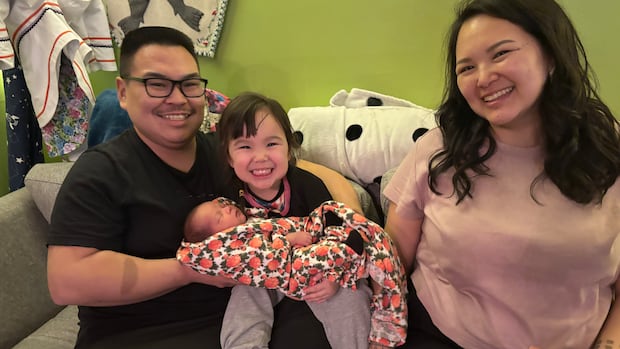
Christine Tootoo had to spend weeks in a hotel, far from home, while she awaited the arrival of her second baby. Tootoo lives in Rankin Inlet, Nunavut, and since there isn't a birthing centre close by, she had to fly to Winnipeg ahead of her due date earlier this year.
She had researched natural birth, packed calming items such as electric candles and room spray, and imagined creating a peaceful hospital environment. But her labour didn’t follow the plan.
One early morning in her hotel room, her contractions came fast and irregular. By the time her partner, Rico Manitok, went to warm up the car, everything changed.
“I felt the urge to push,” Tootoo told Unreserved guest host Juanita Taylor. “I checked and I felt her head … I said, ‘She’s coming right now.’”
Manitok called 911 at 4:12 a.m. Two minutes later, their daughter was born on the floor of a Winnipeg hotel room.
“It was actually an amazing experience,” Tootoo said. “I would do that again.”
Stories like Tootoo's may sound extraordinary, but the circumstances behind them are not.
Across many northern and remote Indigenous communities, families must leave weeks before giving birth to get the medical care they need. Some travel alone, others bring a support person, while children and extended family stay behind.
“People want to stay with their children. They want to stay with their support system,” said Melissa Brown, a midwife and co-founder of an Indigenous doula training initiative.
“We never used to do this alone.”
A common realityBefore the baby came, Tootoo tried to make the best of the wait by taking her older child swimming and visiting parks, in an effort to create moments of normalcy. Still, it wasn't the same as the comfort of home.
“I wish I had the support to be able to birth her in Rankin,” she said.
CBC reached out to Nunavut's Department of Health about the gap in care for pregnant women, but didn't receive a response ahead of publication.
 Christine Tootoo and her husband Rico Manitok are home in Rankin Inlet after giving birth in a Winnipeg hotel. (Juanita Taylor/CBC)
But there are efforts to improve access in remote parts of the country. Brown is Anishinaabe from Sagkeeng First Nation in Manitoba, and Diné or Navajo from the Navajo Nation in Arizona.
She’s a non-practising registered midwife and travels across Canada and the U.S., delivering full-spectrum Indigenous doula training. She's also co-founder of Zaagi’idiwin, an Indigenous-led organization that centres Indigenous people as the experts of the health of their communities.
Brown and her colleague Candace Newman run a four-day training program rooted in Indigenous teachings, ceremony and community care.
Participants range from elders to youth. Some go on to become doulas. Others use the training to support their families.
“We’re just there to draw out the gifts that are already there,” Brown said.
The training blends practical skills such as labour support, breastfeeding and postpartum care, with deeper conversations about colonization, trauma and healing.
WATCH | Saskatchewan opens first on-reserve birthing lodge:Sturgeon Lake First Nation has opened Saskatchewan's first Indigenous-led birthing lodge, aiming to bring birth back home with ceremony, language and family support.It also reintroduces ceremony. In Sioux Lookout, Ont., Brown participated in a placenta ceremony that brought together 25 people to offer prayers and support for a newborn and their parents.
“That’s what our families need,” Brown said. “That circle of support.”
The gap in careAccording to Brown, much of the current system focuses on physical health — prenatal checkups, hospital births, ultrasounds — but often overlooks emotional, cultural and spiritual needs.
Without those supports, families can feel isolated, especially after returning home. That’s where doulas and community caregivers like those trained by Brown and Newman step in.
They help with everything from feeding and newborn care to cooking meals, offering emotional support and simply being present.
“It’s about keeping them warm, giving them tea, listening,” Brown said.
According to research published in the National Library of Medicine in 2017, consistent support during pregnancy and birth improves outcomes. For Indigenous families, access to culturally safe care remains uneven.
 Thea Penashu gave birth to her second child inside a tent, the same way her mother was born over 50 years ago. (Janice Goudie/CBC)
But some communities are beginning to reclaim birthing traditions.
When Thea Penashue was pregnant with her second child in 2020, the Innu mother chose to deliver in a traditional tent set up outside the Labrador Health Centre in Happy Valley-Goose Bay, N.L., combining cultural practice with access to medical care.
Inside the tent, spruce boughs and a mattress covered the ground. Penashue’s husband, mother, doctor, nurse and midwife stayed with her until she gave birth, while her father and extended family waited nearby. As labour intensified, she focused on the generations before her.
“I remember thinking, this is so hard,” said Penashue. “But also telling myself, my grandparents did this. I got this.”
Just after sunrise, her daughter was born.
“The sun was just beaming on the tent,” she said. “It was such an empowered feeling.”
Penashue's experience is part of a broader effort to bring midwifery and land-based birthing back to Innu communities.
She hopes sharing her story will encourage others to see traditional birth practices as possible again. She says many of those traditions were once common practice before being disrupted in the 1960s with the expansion of the health-care system across Canada.
“It was normal then,” said Penashue. “And it can be normal again.”
 Thea Penashue gave birth to her second child in a traditional Innu tent. (Submitted by Thea Penashue)
There are also policy shifts. British Columbia now offers funding for Indigenous doulas, and other provinces are exploring similar models. But Brown says progress is slow.
“It takes time,” said Brown. “It takes community, it takes resources, it takes trust.”
After a few days in Winnipeg, Tootoo and her family flew back to Rankin Inlet. At the airport, relatives gathered to meet the baby.
For Tootoo, being home made all the difference.
“It’s really nice to settle in our own environment,” she said. “Having people come by, checking on us, I enjoy that.”