


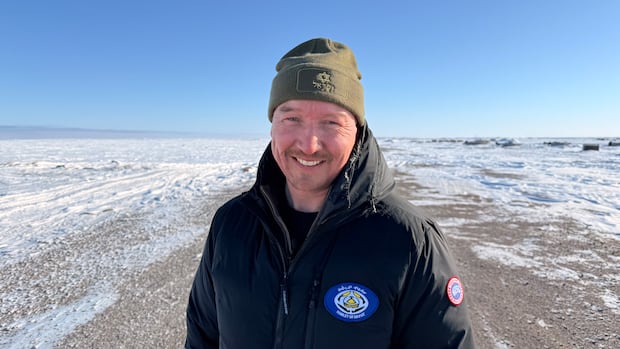

Shannon Fontaine remembers that before his late brother Philippe Pinette was diagnosed with schizophrenia at age 19, he had a talent for math and drawing.
"He was an artist," Fontaine said of his older brother, who died in custody after a "grave violation of human dignity," according to Quebec's ombudsman.
The ombudsman identified several failures in the care provided to Pinette, a 40-year-old Innu man from Uashat, near Sept-Îles on Quebec's North Shore.
Pinette died in hospital on Sept. 19, 2022, while under the care of the Quebec City detention centre.
"My brother supposedly died in jail because he was beaten. No, that's not it at all," Fontaine said during an interview with Radio-Canada at the home in Uashat where he and Pinette grew up.
An autopsy showed Pinette died of severe dehydration eight days after his admission to Quebec City's Hôtel-Dieu de Québec hospital.
Dr. Alain Bissonnette is due back in court next week on a charge of failing to provide the necessaries of life to Pinette between Sept. 2 and Sept. 11, 2022.
WATCH | Philippe Pinette died of severe dehydration:WARNING: This video contains disturbing and graphic details of Philippe Pinette's life in jail. Pinette, a 40-year-old Innu man from Uashat, near Sept-Îles on Quebec's North Shore, died in hospital on Sept. 19, 2022, while under the care of the Quebec City detention centre. The province’s ombudsman pointed out multiple failures in the care provided.The physician appeared in court last October for the case. However, he has yet to enter a plea. He also has not yet announced whether he wants to undergo trial by judge alone or by jury.
The Crown is prosecuting him under Section 215 of the Criminal Code , which addresses the failure to provide the necessaries of life to a vulnerable person in one's care. The charge does not link the doctor to his death.
But failure to provide the necessaries of life carries a maximum sentence of five years in prison.
According to information obtained by Radio-Canada, Bissonnette allegedly failed to act on reports from jail staff recommending that Pinette be transferred to a hospital due to his condition.
Fontaine says it's time for the truth to come out.
WARNING: The following excerpts will contain disturbing and graphic details of Pinette's life in jail.
Drawn-out deathRadio-Canada was able to review the roughly 15 search warrants obtained by the Sûreté du Québec (SQ) as part of its investigation.
The documents detail Pinette's final days after his arrival at the Quebec City detention centre, as he withered away in a padded cell.
 Before his transfer to Quebec City, Pinette was detained at the Sept-Îles detention centre. (Benoit Jobin/Radio-Canada)
It is important to note that at this stage of the proceedings, the allegations have yet to be tested in court.
Pinette was serving a sentence of two years less a day for violent acts committed against staff members in the psychiatric department of the Baie-Comeau hospital. The 40-year-old, who was under public guardianship, was known for his unpredictable behaviour toward care providers, according to a search warrant.
According to the search warrants, Bissonnette requested Pinette's transfer from the Sept-Îles jail to the one in Quebec City, which is better equipped to manage high-needs cases.
Officer likens inmate to 'an animal'The final application for judicial authorization, signed by SQ Sgt. Nancy Tremblay, indicates that the investigation focused on potential criminal negligence causing death.
In the 26-page document, Tremblay describes Pinette’s condition upon arrival in Quebec City as poor, citing a report from a correctional officer who flagged the situation with a list of observations.
On the evening of Pinette’s arrival, Sept. 2, 2022, SQ officer Karina Pelletier noted that the inmate was lying directly on the concrete floor of his padded cell and his arms were twitching. She said he tried to get onto his knees but fell back to the floor. A few days later, on Sept. 5, he was rolling on the floor, naked.
 A rare family photo that Shannon Fontaine, bottom left in the arms of his father Nazaire, treasures. His mother, Mathilda Pinette, is resting her hand on Philippe Pinette. CBC News was unable to obtain a recent photo of Philippe Pinette. (Submitted by Shannon Fontaine)
Pelletier said she saw him use his arm to knock a glass of milk to the ground, which "he licked off the floor like an animal," she wrote in her report.
According to Pelletier, while in detention, Pinette was unable to take his medication, and the inmate repeatedly said words "loudly" that she believed to be Innu or "the mumbling of a person in a panic." He was motionless and made no eye contact with those speaking to him, who were unable to get his attention.
Nurse Annie Tremblay told investigators she raised the need to transfer Pinette to the hospital every day with her supervisor, "who replied that Dr. Bissonnette had refused the requests."
Her colleague, Annie Flamand, also noted that she had heard "the rumour that Dr. Bissonnette knew [Pinette] very well because he had worked with him in the past, and that he was convinced it was a behavioural issue rather than a medical one."
In a report written after the death, the infirmary unit manager, Simon Giroux, describes an exchange he had with Bissonnette on Sept. 8.
Despite Giroux's concern for the inmate’s condition and his nutrition, Bissonnette reportedly advised Giroux that he was giving himself until Monday to evaluate Pinette.
The physician allegedly offered assurances that Pinette would not die if he did not eat over the weekend.
According to the unit manager, the doctor told him clearly: "Don't worry, we won't lose him."
Final daysTestimonies recorded by the SQ about Sept. 9 and Sept. 10 describe a man in a "catatonic" state, soiling himself.
Nurse Flamand told investigators that she attempted to hydrate Pinette and take his vital signs on Sept. 10 but was unsuccessful.
"She waved her finger in front of his eyes, but they remained fixed on the void ahead of him," the search warrant reads.
Based on the search warrant, the man’s body was stiff and his jaw was clenched. Water ran down his cheeks because he was unable to swallow.
According to the nurse’s statement, Pinette’s fingers were so cold and his circulation so poor that it had become impossible to draw a drop of blood to check his blood sugar — a necessary procedure given that he was diabetic.
It wasn't until Sept. 11, after staff noticed he was barely breathing, that Bissonnette authorized his transfer to the hospital.
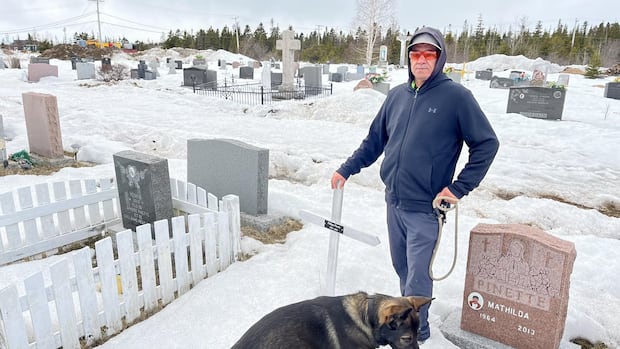
 Pinette is buried beside his mother at the Uashat cemetery. (Benoit Jobin/Radio-Canada)
Pinette was transported by ambulance, first to the Hôpital de l’Enfant-Jésus and then to the Hôtel-Dieu de Québec, where he was placed in a medically induced coma and on permanent dialysis.
The final autopsy report dated May 2023, cited in the police document, attributed the death to "severe dehydration and its complications."
The Band Council of Uashat mak Mani-utenam said in a statement published Wednesday evening that it is currently analyzing all available information and will "take the time necessary to learn more about the situation."
"This story revives deep wounds within our community, particularly regarding the wave of suicides that happened in the 1990s at the Sept-Îles detention centre," the statement reads. "This is a sensitive context that deserves serious attention and reflection."
In a statement posted on Friday, the Band Council called on Premier Christine Fréchette to recognize systemic racism affecting First Nations communities in Quebec.
"The refusal to name this reality constitutes a major obstacle in implementing sustainable and appropriate solutions," the statement read.
"As long as the realities experienced by our members aren't clearly recognized, including the existence of systemic racism, any changes will remain insufficient," Chief Jonathan Shetush said.
On Thursday, the Office of Joyce's Principle — an advocacy group that calls for all Indigenous people to have the right of equitable access, without any discrimination, to all social and health services — denounced the "serious failings on the part of public institutions that had responsibility" for Pinette.
"The death of Philippe Pinette reveals serious professional failings. It is neither an isolated incident nor a single individual error, but rather an institutional failure with irreversible consequences," read the statement from Jennifer Petiquay-Dufresne, executive director of the Office of Joyce's Principle.
The Collège des médecins confirms that Bissonnette is allowed to practise medicine without restrictions but refused to confirm or deny whether a disciplinary investigation into his conduct is underway.
Local health authorities, CIUSSS de la Capitale-Nationale and the CISSS de la Côte-Nord declined to provide interviews regarding the specific events surrounding Pinette’s death. They did, however, offer assurances that corrective measures have been implemented to address the recommendations issued by the Quebec ombudsman.
Quebec's Public Security Ministry refused to comment on the matter due to the ongoing case.
If you’re affected by this report, mental health counselling and crisis support are available 24 hours a day, seven days a week for Indigenous people through the Hope for Wellness hotline at 1-855-242-3310 or by online chat.
You can also look for mental health support through resources in your province or territory.