


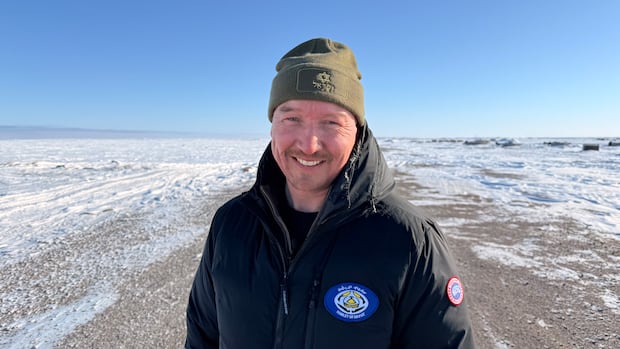
With Canadians across the country watching, Joe Savikataaq Jr. proudly showcased his community of Arviat, Nunavut, the home of the new Inuit Nunangat University.
Stitched into the military-green tuque the mayor wore, as seen in a CBC News story last month, is a hexagram. It’s the Star of David, and below it is the word Israel in Hebrew.
That has sparked conversations over what was supposed to be a celebration for the university. Amid high tensions over the Israel-Hamas war, that symbol has become a sensitive subject, and its use at a public event has drawn more than a dozen posts and hundreds of comments on social media from people in Nunavut, Greenland and elsewhere in Canada.
Savikataaq Jr. insists he wasn’t making a political statement, and he does not regret wearing it.
“A hat is a hat, whether it's [an] Edmonton Oilers hat, Toronto Maple Leafs, Montreal Canadiens ... it’s just a hat and nothing was said. No one was endorsed. There was absolutely nothing done,” he said, adding that he broke no laws.
He has the backing of some Nunavummiut, like Sarah Netser. As a member of several Christian congregations in Nunavut, she said supports the use of the Star of David.
"It's not a wrong thing to use. In the Bible we’re asked to pray for the peace of Jerusalem," she said.
Some of the discourse online include attacks on Savikataaq Jr.'s personal life, the community of Arviat, and critics speaking out.
 Arviat resident Qavangat Angalik says she didn't know much about Israel-Palestine relations before the war broke out. But now, she sees the support for Israel as a symbol of xenophobia. (Submitted by Qavangat Angalik)
That compelled Arviat resident Qavangat Angalik to make a post saying the debate is distracting from the real issue, which is the use of the Star of David symbol, which she says is that the mayor's use of the symbol is inappropriate.
“Our leaders ... they should not be dividing people like this," she told CBC News.
The meaning of the symbolAt its core, the Star of David represents Jewish identity and the religion of Judaism.
But after the symbol was chosen as the Jewish National Flag at the first Zionist Congress in 1897, it also became an emblem of Zionism.
Mira Sucharov, a professor of political science specializing in Israeli-Palestinian relations at Carleton University, says it’s important to look at the context of how the symbol is being used.
She says if she saw someone with a necklace with a Star of David pendant, she wouldn’t assume any relationship to the state of Israel or Zionism — but it gets more complicated when the person is not Jewish.
Another aspect to look out for is the way the symbol is presented on a garment, such as whether it’s embedded with a flag or the colours of the flag.
“What I'm going to infer is that person is probably making some sort of political statement signaling some sort of sense of alliance with the state of Israel,” she said. “Now, as to people who are wondering what the mayor intended, I think the best thing is to ask him.”
Savikataaq Jr. said wearing the hat had nothing to do with the Israel-Hamas war.
In 2025, Savikataaq Jr. also wore a hat with the Star of David in a story in Kivalliq News.
 Beth Kotierk, an Inuk lawyer now in Ottawa, believes the lines between religious belief and political ideology are being blurred. (Submitted by Beth Kotierk)Religious belief vs. political ideology
Some Inuit like Beth Kotierk — who converted to Islam nearly three years ago — believe the tuque was an intentional choice.
The Inuk lawyer, originally from Igloolik but now living in Ottawa, believes there are appropriate ways — mostly for Jewish people — to wear the Star of David. But right now, she believes it is being co-opted politically.
“It's a signal of support for Israel, the modern nation state that is a settler colony that is conducting this violent genocide and expanding its borders,” she said.
Kotierk believes the lines between religious belief and political ideology are being blurred — pointing to Pope Leo XIV's condemnation of the treatment of Palestinians in Gaza.
“There's not much backing this religious argument because it's not a religion, it's actually being condemned by religion,” she said.
Tristin Tukalak-Mount, a psychology student originally from Puvirnituq who now lives in Montreal, believes you can support Jewish identity without supporting the actions of Israel.
 Tristin Tukalak-Mount believes you can support Jewish identity without supporting the actions of Israel in the war. (Submitted by Tristin Tukalak-Mount)
“There are folks who will use the Star of David as [a symbol of] support for Jews and for Jesus … However, there are also people who use the Star of David as support for Jesus, but also by that same token, supporting Israel,” he said.
“Two things can exist at the same time. You can love Jesus and you can also not support what's going on currently.”
Religion in NunavutAngalik says the matter is made more complicated by the legacy of residential schooling.
Residential schools in Nunavut were primarily run by missionaries. Founded on notions of racial and cultural superiority, the schools attempted to convert Indigenous children to Christianity.
Angalik says she sees how much “Christian evangelism” has taken hold in her community. That makes her feel ostracized from the rest of her community, but she’s continuing to hold onto her beliefs.
“I find it very hypocritical that a lot of Inuit are not recognizing the common history you'd have with Palestinians because of colonization,” she said.
LISTEN | Global Indigenous Solidarity with Palestine:Unreserved56:15Global Indigenous Solidarity with Palestine
‘All our relations’ is a saying often heard in the Indigenous community. Many from Turtle Island feel a responsibility to care for relations across the globe. As violence and uncertainty continue in Gaza, Rosanna speaks with Indigenous artists, activists and health care workers about the connection they feel with Palestinians, and how they’re driven to speak out, take action and make space for grief and healing.The United Nations has previously called for the “inalienable right of the Palestinian people to self-determination”, and in September, Canada made the move to recognize the state of Palestine.
As for Savikataaq Jr. wearing the toque and the reactions that has drawn, Angalik wants people to remember values rooted in Inuit culture.
“We need to practice Inuit Qaujimajatuqangit, not to deter different people," she said. "You are very proud to be welcoming, but this is not welcoming at all.”